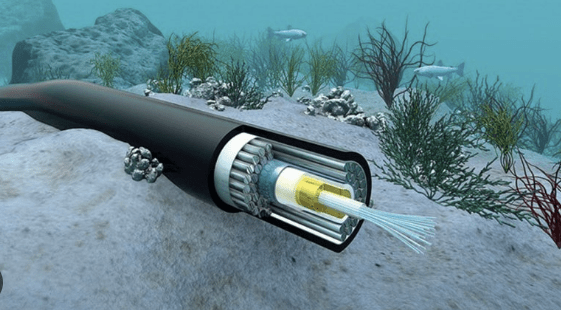
Submarine cables are no longer a niche part of the power industry.
They are becoming one of the most strategic pieces of infrastructure in the age of electrification. As offshore wind expands, long-distance transmission grows, and AI-driven electricity demand rises, the value of moving large volumes of power reliably over long distances is increasing fast. That is why submarine power cables now matter far beyond the cable industry itself. They sit at the intersection of energy transition, grid modernization, and industrial policy.
1. Why submarine cables matter now
The world is entering the age of electricity.
That means more renewables, more grid investment, more long-distance transmission, and more power-hungry digital infrastructure. Long-term global electricity demand is projected to rise sharply, and AI data centers are adding a new layer of load growth that reinforces the need for stronger transmission infrastructure. In that environment, submarine cables become essential because they connect offshore generation to land, link regional power systems, and make long-distance HVDC routes feasible.
So the real point is simple:
submarine cables are no longer just a utility component.
They are now part of strategic energy infrastructure.
2. Offshore wind growth is directly pushing submarine cable demand
The biggest direct driver is offshore wind.
GWEC says global wind capacity is expected to pass 2 TW by 2030, and while that includes both onshore and offshore, offshore remains one of the most cable-intensive segments because every project requires export cables, array cables, and usually higher-spec grid connections. Reuters also reported today that global wind additions hit a record in 2025, reinforcing that renewable buildout is still moving higher despite policy noise.
Regionally, the picture is mixed but still constructive.
The U.S. has more short-term policy uncertainty, Korea is shifting to a government-led offshore wind model, Taiwan continues to build, and Southeast Asia has rising long-term potential. Korea’s new offshore wind framework is especially important because it replaces the old developer-led “open door” model with a more state-directed process designed to accelerate project execution.
3. The submarine cable market has high entry barriers
This is not a commoditized market.
Submarine power cables require know-how in extra-high voltage, long-distance reliability, marine installation, and project execution that goes well beyond ordinary land-based cable manufacturing. That is why the global competitive set remains narrow. The market continues to revolve around a relatively small group of qualified players such as Prysmian, Nexans, NKT, and LS Cable & System. Korea’s LS is increasingly being mentioned alongside the European Tier-1 names because qualification barriers are high and project experience compounds over time.
That is what makes the industry attractive.
Once a supplier is qualified at the high end, replacement is difficult and pricing power improves.
4. Demand is rising faster than supply in key segments
The important point is not just demand growth.
It is that qualified supply is still limited. Industry reporting around HVDC and offshore wind keeps emphasizing that installation vessels, high-voltage manufacturing capacity, and full turnkey experience remain bottlenecks. That is exactly why backlog has become so valuable for the leading suppliers. LS Cable reported its order backlog rose to 7.63 trillion won at the end of 2025, up about 22% year on year, which is one of the clearest signs that demand is outrunning immediately available supply capacity.
So this is not just a growth market.
It is a market where constrained supply can amplify earnings quality.
5. Korea’s submarine cable market is finally getting policy support
Korea’s domestic setup has changed materially.
The Offshore Wind Promotion Act passed in February 2025, and the National Power Grid Act also passed around the same time, creating a more supportive legal framework for both offshore wind development and backbone grid expansion. Legal and market commentary says the offshore-wind law gradually takes effect from 2026, while the grid law has already become a structural support for transmission buildout.
That matters because Korea’s offshore-wind problem was never only technology.
It was permitting, coordination, and grid linkage. Those are exactly the areas the new laws are trying to fix.
6. The West Coast Energy Highway is the biggest domestic HVDC story
The most important domestic project is clearly the West Coast Energy Highway.
Recent reporting says the project is centered on an 8 GW HVDC backbone and that phase one, linking Saemangeum to the Seoul metropolitan area, is being accelerated toward 2030 completion. Other coverage describes the broader west-coast route as the centerpiece of Korea’s long-term national energy expressway.
For the market, the significance is straightforward.
This is not just one transmission project. It is a domestic proof point for HVDC converters, transformers, substations, subsea cable, and marine installation. That is why the Korean HVDC value chain matters so much now.
7. Anma and Shinan Ui show that project conversion is becoming real
The offshore-wind pipeline is no longer abstract.
For Anma Offshore Wind (532 MW), LS Cable & System and LS Marine Solutions secured separate contracts in 2025. Public reports said LS Cable’s contract was about KRW 161 billion and LS Marine Solutions’ was about KRW 94 billion, with full-scale construction expected to ramp from 2027.
For Shinan Ui (390 MW), LS Marine Solutions was named preferred bidder for submarine cable construction, and industry reporting last week said the project completed financial-close arrangements with construction funding starting to flow in 2026. LS Marine said cable construction is scheduled for 2027 and commercial operation for early 2029.
These projects matter because they turn the Korean submarine-cable story from policy hope into executable backlog.
8. Vietnam, Singapore, and the regional HVDC map are long-term upside
The overseas opportunity is not limited to Korea.
Singapore’s Energy Market Authority granted conditional approval for 1.2 GW of electricity imports from Vietnam via new subsea cables, as part of Singapore’s broader plan to import up to 4 GW of low-carbon electricity by 2035. PTSC’s 2024 sustainability report says the initial 1.2 GW export phase sits within a larger 2.3 GW offshore wind project targeting commercial operation by 2033.
That makes Southeast Asia strategically important.
It is one of the clearest regions where offshore wind, cross-border power trade, and submarine transmission can merge into a real multi-decade project pipeline.
9. The real moat is turnkey capability: cable plus installation
This is the part that matters most.
Making cable is one business. Delivering a full cable-plus-installation turnkey solution is a much stronger one. That is why the LS group structure matters. LS Cable & System gives the manufacturing layer, LS Marine Solutions gives installation, and LS Eco Energy provides an additional overseas expansion angle. LS Marine has been expanding its offshore-wind and submarine-installation role, and Korean media note that its revenue jumped sharply in 2025 as these projects converted.
The investment logic is simple.
In submarine cables, vertical integration matters.
The winner is not always the company that can make cable.
It is often the company that can make it, lay it, and deliver the project on time.
 The Morning Calm Notebook
댓글 남기기