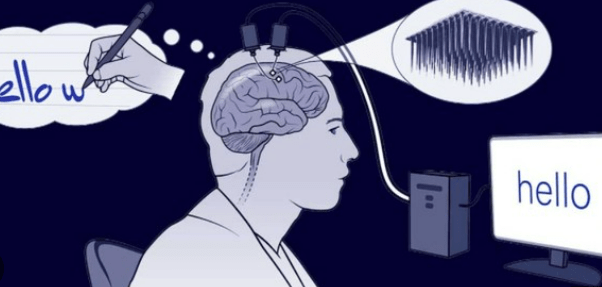
The essence of brain-computer interface technology is simple to describe, but difficult to build.
A user imagines an action or intention. The system captures the brain signal, decodes it through electrodes, chips, and algorithms, and then turns that decoded intention into control of an external device such as a cursor, robotic hand, prosthetic limb, or digital interface. In other words, BCI is about converting thought into action through a loop of signal input, signal processing, device control, and feedback adjustment. That is why the technology is starting to move from fascination to utility.
1. The real essence of BCI is turning intention into action
The cleanest way to think about BCI is this:
intention → decoding → realization
A person imagines movement or intent, the machine reads the neural pattern, and an external system executes the action. China Daily’s reporting on recent Chinese clinical progress makes this very concrete: patients have already used BCI systems to control cursors, smart-home functions, gaming interfaces, and robotic hands. That is why BCI should no longer be framed as a futuristic idea alone. It is increasingly becoming a practical interface layer between the brain and machines.
2. There are three main technological paths in BCI
BCI is usually divided into invasive, semi-invasive, and non-invasive approaches.
Invasive BCI places electrodes directly in the brain, delivering the highest signal quality and resolution, but also carrying the greatest surgical risk and cost. Semi-invasive BCI tries to balance performance and safety by placing the system under the skull or through vascular or extradural routes. Non-invasive BCI uses methods such as EEG from outside the scalp, making it safer, easier to deploy, and more scalable for mass-market use. Market research still shows non-invasive hardware dominating the current market, while China’s recent breakthroughs suggest semi-invasive and invasive approaches are gaining much more attention in the medical setting.
For a blog post, that is the most useful way to frame it:
non-invasive leads today in accessibility,
semi-invasive may become the key middle path,
and invasive remains the highest-performance frontier.
3. The industry is really built on electrodes, chips, and decoding software
The BCI value chain starts upstream.
Electrodes are the antennas that capture neural signals. Chips amplify, filter, and transmit those signals while operating at extremely low power. Software and decoding algorithms determine how fast and how accurately user intent can be interpreted. The real competitive edge sits in system integration: precise hardware + strong signal processing + intelligent software. That is why BCI is not just a neuroscience story. It is also a semiconductor, firmware, and algorithms story. China’s recent clinical advances, including fully implanted wireless systems and minimally invasive designs, show that hardware-software integration is already becoming a core battleground.
4. Medicine comes first, but non-medical applications may eventually become larger
Today, BCI is still most compelling in medicine.
The near-term use cases include spinal cord injury, paralysis, stroke rehabilitation, Parkinson’s disease, epilepsy, and selected neuropsychiatric conditions. That is where the value proposition is clearest, because even small gains in motor recovery or communication ability can be life-changing. Reuters reported in March that China expects broad public use of BCI in the next three to five years, with current trials focused heavily on medical rehabilitation.
But the long-term market could become much broader.
As signal quality, comfort, and cost improve, BCI can expand into education, entertainment, gaming, sleep, wellness, smart-home control, and industrial interfaces. That is where non-invasive systems, especially consumer-facing ones, may ultimately create the largest volume market.
5. The global BCI race is being shaped differently in the U.S. and China
The United States still has some of the most visible BCI names.
That includes Neuralink, Synchron, and big-tech-adjacent ecosystem interest. The U.S. advantage remains strong in frontier engineering, capital markets, and the ability to attract top technical talent. China, however, is building a different model: one based on central policy support, provincial commercialization, standard-setting, clinical scale, and manufacturing integration. Reuters reported in March that China has prioritized BCI in its latest planning framework and expects major breakthroughs by 2027, with globally competitive firms targeted by 2030.
That is why the competitive structure matters.
The U.S. is still strong at the frontier. China is trying to become faster at industrialization and deployment.
6. China’s real weapon is not one company. It is the full policy stack
China’s strength in BCI comes from system-level coordination.
The central government sets strategic direction, while local governments and hospitals support trials, commercialization, and reimbursement pathways. Reuters reported that some BCI treatments have already been integrated into health insurance systems in select provinces, and Global Times reported that the assignment of a medical-insurance code makes it possible for BCI implantation procedures to enter the reimbursement system.
China is also moving aggressively on standards.
Official and quasi-official reporting says the country has been releasing BCI-related standards covering terminology, evaluation methods, and device-performance testing. At the same time, China has a very large patient pool, lower clinical costs, and strong research-hospital-industry coordination. That is why China’s advantage is not just funding. It is the ability to connect research, clinical validation, manufacturing, and policy into one loop.
7. China’s BCI market is now large enough to matter
The Chinese BCI market is no longer too small to care about.
Xinhua and other official-linked reporting say the market was worth 3.2 billion yuan in 2024 and is expected to reach about 6.1 to 6.14 billion yuan by 2028, implying a CAGR of roughly 17% to 18%. Those numbers are not huge in absolute terms yet, but they are large enough to support meaningful commercial ecosystems, especially when combined with policy support and clinical demand.
Just as important, the sector is attracting capital.
Reporting this year says StairMed raised 500 million yuan, while BrainCo has been linked to a major Hong Kong IPO push and large private funding rounds. That tells you BCI in China is moving from pure science funding toward real capital-market participation.
8. BrainCo, Neuracle, and StairMed each represent a different path
BrainCo is the clearest non-invasive commercialization story.
It comes out of a Harvard-linked background and has built products spanning bionic hands, focus-related devices, and pediatric or consumer-oriented applications. Recent reporting says BrainCo turned profitable in 2025 and confidentially filed for a Hong Kong IPO in early 2026. That makes it one of the rare BCI names with a visible bridge from lab technology to real revenue.
Neuracle represents the medical-device breakthrough path.
Shanghai Pudong’s official English site said in April 2026 that Neuracle’s implantable BCI system for hand-motor compensation became the world’s first invasive BCI device approved for market entry by China’s NMPA. Reuters separately reported China had become the first country to approve commercial use of a BCI medical device, describing it as a minimally invasive system assisting patients with quadriplegia. For publication, the safest wording is that China approved the first commercial BCI medical device, while local government coverage framed the Neuracle product as a world-first invasive approval.
StairMed is the invasive frontier bet.
The company has roots in the Chinese Academy of Sciences ecosystem and recently raised 500 million yuan in a funding round led by Alibaba and joined by Tencent, which is notable because joint investment by those two firms is rare in this sector. Recent reporting says StairMed is pushing ahead with large-scale clinical work, making it one of the most visible invasive BCI names in China.
9. The real investment conclusion is not “BCI is coming someday.” It is that the stack is already forming
The important thing now is not whether BCI sounds futuristic.
It is whether the ecosystem is becoming investable. In China, the answer increasingly looks like yes. The building blocks are now visible: more than 200 companies, a formalizing reimbursement path, clearer standards, multiple clinical approaches, regulatory approvals, and rising capital inflows. China Daily described this as an innovation ecosystem that integrates fundamental research, engineering, and clinical adoption into a streamlined path from lab to real-world use.
That is why BCI should be read less like science fiction and more like an emerging industry stack.
The fantasy was mind control.
The reality is much more interesting: thought becoming interface.


답글 남기기