China’s next phase is not just about inventing better technology.
It is about turning technology into industrial scale faster than anyone else. That is the real meaning of the next five years. The policy language is increasingly centered on self-reliance, digitalization, AI adoption, energy infrastructure, and industrial upgrading, but the more important point is how these goals connect to physical systems. China is trying to turn compute, power, manufacturing, logistics, and data networks into one integrated industrial machine.
1. Why China is less vulnerable to war-related energy shocks than many expect
One reason China appears relatively more resilient to short-term external shocks is energy structure.
Yes, China still relies heavily on imported oil. But its broader energy system remains anchored by domestic coal, and overall energy self-sufficiency remains high by the standards of a large industrial economy. China National Petroleum Corp.’s research arm said China’s energy self-sufficiency rate reached 84.4% in 2025, and China Daily reported the figure is expected to improve further to 84.6% in 2026. CNPC-linked reporting also said coal self-sufficiency remains near 90%.
That does not mean China is immune.
It means the country’s overall economy is less exposed to a pure short-term oil shock than many people assume, because the energy base underneath the economy is still dominated by domestically available fuel and increasingly supported by renewable buildout.
2. The 15th Five-Year Plan is the bridge from policy to industrialization
Each Chinese five-year plan has had a different economic center of gravity.
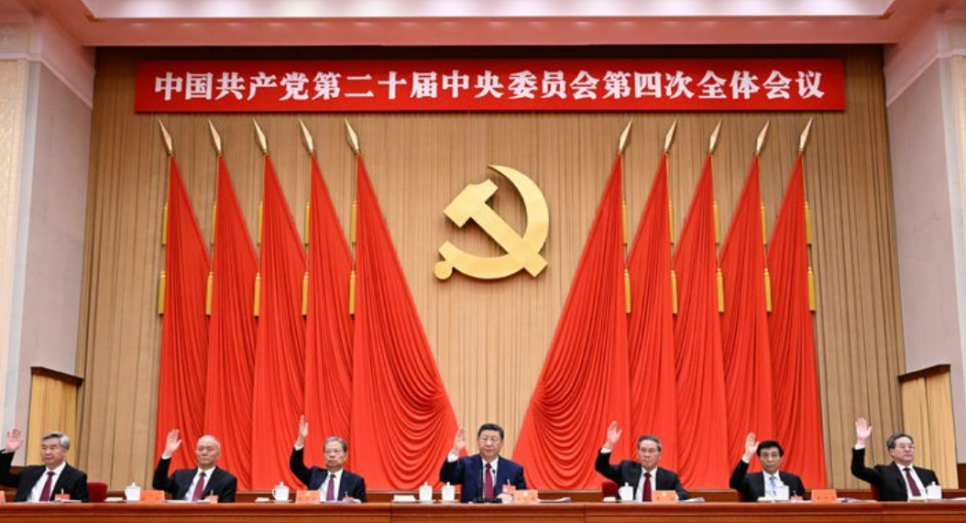
The 15th Five-Year Plan, covering 2026 to 2030, is being read by major analysts as a plan focused much more explicitly on technological self-reliance, digital development, AI integration, energy systems, and next-generation infrastructure. IISS says the plan reflects continued strategic emphasis on technological growth, while DigiChina and MERICS both highlight AI, Digital China, industrial policy, and strategic autonomy as core themes.
That is why the next five years matter.
China is not just setting targets. It is trying to convert those targets into industrial systems that can scale.
3. The real contrast with the U.S. is technology leadership versus infrastructure industrialization
The U.S. still leads in several high-end areas.
It remains stronger in frontier LLMs, advanced upstream semiconductor technology, and much of the global talent and compute ecosystem. But China’s advantage lies somewhere else: power, manufacturing scale, critical minerals, and the speed of applied rollout. China’s power generation is still dramatically larger than America’s, and in rare earth refining it remains overwhelmingly dominant. The IEA said last week that China accounts for around 60% of magnet rare-earth mining, above 90% of refining, and about 95% of permanent magnet production.
So the real competition is asymmetric.
America still leads more of the frontier. China is trying to win through infrastructure depth and industrial deployment speed.
4. The power grid may be the most important industrial project of the next five years
China’s next industrial leap depends on electricity.
Reuters reported in January that State Grid plans to invest 4 trillion yuan from 2026 to 2030, a 40% increase over the previous five-year period, implying average annual investment of roughly 800 billion yuan. State Grid’s own state-asset disclosure confirms the same broad target, while China Daily reported an even broader grid-investment figure of around 5 trillion yuan when including wider system spending.
That matters because the more renewable-heavy the system becomes, the more China needs UHV transmission, storage, pumped hydro, distribution upgrades, and grid-balancing systems.
In other words, the power grid is no longer a utility story. It is becoming an industrial-policy story.
5. In semiconductors, China is pushing localization across the entire stack
China’s semiconductor strategy is becoming more comprehensive.
The goal is not just to make more chips. It is to localize more of the supply chain across memory, equipment, EDA, IP, and accelerator platforms. Reuters has already shown that China’s chip push is now directly tied to broader strategic containment concerns, while Big Fund III — launched with 344 billion yuan — is the clearest financial sign of this long-term intent.
Some of the exact localization ratios in your draft are directionally plausible, but they vary by source and segment. A safer public framing is this: China has made meaningful progress in lower-end and mature-node localization, while still remaining much weaker in high-end lithography, advanced inspection, and top-tier design software. Industry reporting this month says China has pushed equipment localization higher, but core dependence remains in leading-edge categories.
6. Optical modules are a very important but underappreciated battleground
China is also strong in an area that matters much more in the AI era: optical modules.
As networking speeds move from 100G to 400G, 800G, 1.6T, and eventually 3.2T, the value of reliable suppliers rises sharply because qualification barriers are high and incumbency matters. That is why names such as Innolight are strategically important. I could not verify every exact shipment figure in your draft from a primary source in this pass, so I would avoid hard-coding those production numbers. But the broader point is correct: China has globally relevant strength in optical interconnect hardware, and that gives it a serious foothold in AI infrastructure beyond semiconductors alone.
The strategic takeaway is simple.
Once you enter the certified optical supply chain, you are much harder to replace than a generic component supplier.
7. China’s real edge is industrialization and scale
This may be the most important point in the whole piece.
China’s advantage is not always that it invents first. It is that it often industrializes faster, scales faster, and diffuses faster once a technology enters the real economy. That pattern is now visible in humanoids, industrial robotics, smart factories, and autonomous mobility. Rest of World reported that nearly 90% of all humanoid robots sold globally in 2025 were Chinese, while another widely cited 2026 ranking showed the leading shipment brands were overwhelmingly Chinese, led by Unitree, AgiBot, and UBTECH.
That is why China’s technology story increasingly looks less like a lab story and more like a factory story.
8. In robotics, actuators are where the economics begin
If you want to understand Chinese robotics, start with actuators.
They are one of the largest cost centers in industrial robots and an even more important share in humanoids. The exact ratios vary by robot architecture, but industry analysis consistently shows that motion systems — actuators, reducers, motors, sensors, and controllers — dominate the bill of materials. That is why the robotics opportunity in China is not just about the finished humanoid brand. It is also about the dense component ecosystem underneath it.
That is how China usually wins.
Not only through the finished product, but through control of the supply chain beneath the product.
9. Low-altitude economy, satellites, and rockets are the next frontier of industrial rollout
China’s so-called low-altitude economy is also becoming a major policy industry.
Official and semi-official sources say the market size is expected to reach around 1.5 trillion yuan and could exceed 3.5 trillion yuan by 2035. Government-linked reporting also shows the sector has been elevated to national-policy status, with strong emphasis on smart networks, unmanned systems, and supporting infrastructure.
Some of the precise figures in your draft around airport counts and landing platforms are difficult to verify from authoritative primary sources, so for a blog post I would frame the point more carefully:
China is treating low-altitude infrastructure as a strategic buildout area, and that likely creates spillover demand for eVTOL systems, drone networks, smart control systems, satellite internet, and launch services.
That is also why names such as LandSpace, CAS Space, and Unitree fit the broader story of China’s next five years: not just innovation, but scaled industrial deployment.
10. The real conclusion: China’s next five years are about turning technology into factories
That is the real message.
The next five years in China are not just about catching up in one or two frontier sectors. They are about converting technology into industrial systems across power, semiconductors, networking, robotics, and mobility infrastructure. The 15th Five-Year Plan is important not because it promises new ideas, but because it tries to turn those ideas into physical capacity, localized supply chains, and scalable deployment.
That is why the market should stop asking only whether China can invent.
The more important question is whether China can industrialize at national scale faster than the rest of the world.
And that is where the real competitive pressure is building.


답글 남기기