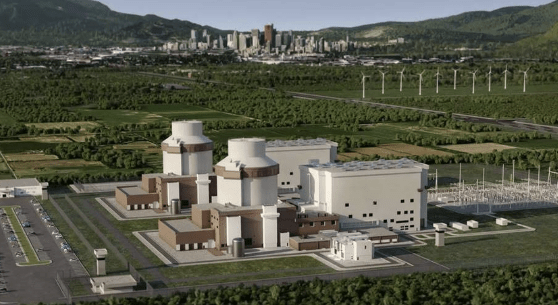
If large-scale nuclear power is really coming back to the United States, Texas may be one of the most important starting points.
That is because Texas offers a rare combination: relatively low power costs, extremely fast-growing data-center demand, and a deregulated power market where long-term bilateral contracting is more feasible than in many other states. That makes it one of the most natural places for new nuclear to be tied directly to AI infrastructure. Fermi America’s Project Matador is being framed in exactly that way — not just as a power project, but as part of a much larger energy-and-AI complex.
1. Why Texas, specifically?
Texas matters first because electricity is cheaper.
According to EIA’s January 2026 state price table, Texas commercial power averaged 8.64 cents/kWh and industrial power 7.25 cents/kWh, while California was at 23.13 cents and 19.11 cents, respectively. That is a massive difference for any power-hungry AI campus. For large data centers, this cost gap is not a minor operating detail. It becomes a strategic advantage.
Texas also matters because demand is exploding.
ERCOT’s latest preliminary forecast says peak load in Texas could rise from about 98,087 MW in 2026 to 111,318 MW by 2032 in its base case, with data centers driving most of that growth. In the higher-load scenarios tied to large-load pipelines, the upside becomes dramatically larger. That is why Texas is not just a cheap-power state. It is becoming one of the main battlegrounds for AI-era electricity demand.
The third reason is market structure.
Texas’s competitive power market makes long-term commercial arrangements more flexible than in many regulated states. That matters because AI developers increasingly want direct and durable access to power rather than simply hoping the grid will catch up later. Fermi’s own positioning around a behind-the-meter “HyperGrid” reflects exactly this logic.
2. Why large nuclear is becoming important again
The reason is reliability.
When the customer is an AI data center, the key question is not just carbon intensity. It is whether power can be delivered continuously, at scale, and with a high capacity factor. EIA’s 2024 final annual data show nuclear with very high capacity factors relative to most other generation types, and historically U.S. nuclear runs in the low-90% range. That is what makes it such a strong fit for 24/7 baseload demand.
That is why large nuclear is back in the discussion.
Not because it is easy, but because it solves a problem that intermittent resources do not solve on their own: stable, round-the-clock power for critical infrastructure. In the AI era, that matters more than it did before.
3. Why Hyundai E&C matters in this story
The most important development is not yet EPC.
It is FEED.
World Nuclear News reported that Fermi signed a Front-End Engineering Design contract with Hyundai Engineering & Construction for four AP1000 reactors at Project Matador. Under this contract, Hyundai E&C is responsible for the first-phase engineering work, including site layout, cooling-method review, and budget and schedule estimates. That is strategically important because FEED is the stage where the cost baseline, construction logic, and execution structure begin to take shape.
That is why FEED matters more than many people think.
If you secure FEED, you are not just supplying engineering hours. You are positioning yourself to shape the project before the main EPC contract is finalized. In large nuclear, that can translate into much stronger leverage in the next negotiation phase.
For a WordPress post, I would avoid hard-coding the exact 45% Hyundai / 55% Westinghouse structure unless that split is directly confirmed in a primary project source. But the broader logic is still valid: Westinghouse leads with reactor technology and key nuclear-island design, while Hyundai’s likely value is strongest in construction execution and broader EPC scope around the plant. That is the cleaner way to present it.
4. The current Fermi project is AP1000-based, not yet a mixed AP1000/APR1400 structure
This is one place where it helps to be precise.
Publicly confirmed project materials today point to four Westinghouse AP1000 reactors at Project Matador. Fermi submitted its Combined Operating License Application for four AP1000 units in June 2025, and World Nuclear News reported that the company aims to begin construction the following year with the first reactor targeted for operation by 2032.
So for now, the confirmed base case is not AP1000 two units plus APR1400 two units.
It is AP1000 four units, with Korean companies brought in through engineering and equipment partnerships. That does not weaken the Team Korea angle. It just means the current project should be described as a Korean execution partner embedded in a Westinghouse-led reactor platform, rather than as a formal dual-reactor-type structure.
5. Why the Westinghouse ownership and Vogtle history both matter
Westinghouse’s ownership structure matters because it reflects how strategic U.S. nuclear has become again.
Reuters reported in October 2025 that Brookfield owns 51% of Westinghouse and Cameco owns the remaining 49%. That same report also tied Westinghouse directly to the U.S. push for a large-scale nuclear restart.
But the bigger context is Vogtle.
Reuters reported that the last two AP1000 reactors at Vogtle came in about seven years late and cost around $35 billion, versus an original estimate of $14 billion. That is why the market remains cautious about any new U.S. nuclear build, even when the strategic logic is sound. Vogtle is both the proof that the U.S. can still finish a large reactor and the warning that execution risk is still enormous.
That is exactly why Hyundai E&C’s role is important.
Its appeal is not theoretical technology. It is execution credibility.
6. Why Korea’s position can strengthen from here
This is the deeper investment point.
The U.S. wants large nuclear back, but its own recent construction history is thin and painful. Korea, by contrast, still has live industrial memory in nuclear construction, plus an export reference through Barakah that is consistently viewed as much stronger on schedule and cost discipline than recent U.S. precedent. Hyundai E&C itself stressed in the Fermi announcement that it sees this as a chance to leverage its track record as a builder that has delivered large-scale nuclear projects on time and on budget.
So the strategic implication is straightforward.
If America’s nuclear renaissance becomes real, Korea does not necessarily need to win only with its own APR1400 exports. It can also win by becoming the trusted execution partner inside a broader U.S.-led large-reactor revival. That may be the more realistic and commercially powerful path in the near term.
7. The real significance of Fermi is not one project, but the template
Fermi matters because it may become a template for the AI-era nuclear buildout.
The project is being designed not as a traditional stand-alone utility asset, but as part of a co-located energy-and-data infrastructure complex. Reuters described it as a plan to build the world’s largest integrated energy and data complex, combining nuclear, gas, solar, batteries, and AI data-center load on one campus.
That is the real shift.
The next nuclear cycle in the United States may not be driven first by traditional grid logic alone. It may be driven by AI, hyperscale power demand, and private energy campuses.
And if that is true, then Texas — and execution partners like Hyundai E&C — become much more important than they first appear.


답글 남기기