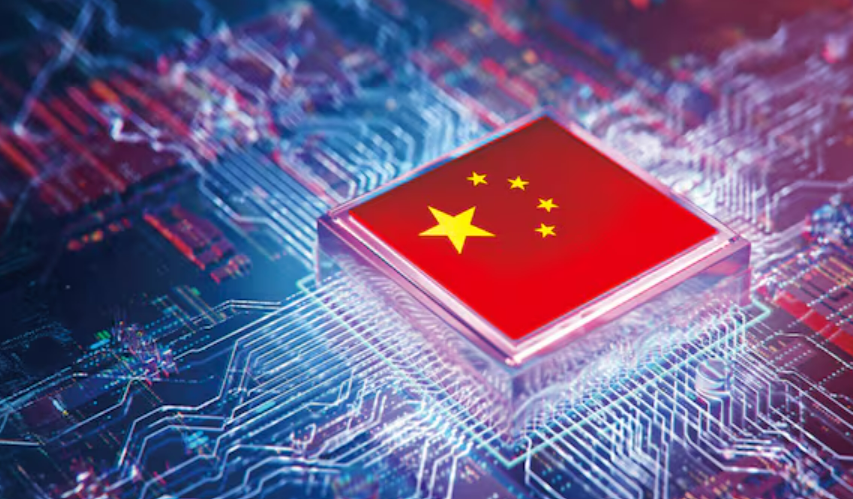
The semiconductor war is no longer just about who has the best chip.
It is now about who can control the supply chain, who can localize the critical bottlenecks, and who can combine memory, foundry, packaging, software, and design services into one usable platform. China is pushing hard toward self-reliance by building a more separated domestic semiconductor chain, while Korea’s opportunity is taking a different form. As China pushes upstream and midstream localization, Korea’s strength in advanced memory, foundry integration, and system-level execution may actually become more valuable, not less.
1. The essence of China’s semiconductor strategy is supply-chain separation
China increasingly treats AI compute as a strategic asset tied to national security.
That is why its semiconductor push is no longer just about catching up technologically. It is about reducing dependence on U.S.-linked hardware, software, and process chokepoints. Recent reporting shows Chinese chip executives explicitly calling for a national push to build a domestic equivalent of ASML and to close gaps in EDA, materials, and lithography during the 2026–2030 period. Taiwan’s national security authorities also warned this week that China is intensifying efforts to obtain advanced semiconductor capabilities to evade external technological containment.
In other words, the real logic of China’s chip strategy is not just growth.
It is supply-chain separation and self-reliance.
2. Where the money in Big Fund III is going
The third phase of China’s state-backed semiconductor fund is huge.
Reuters reported that Big Fund III was established with 344 billion yuan in registered capital, making it the largest phase of the national integrated circuit fund so far. The broad purpose is to strengthen self-sufficiency under U.S. export controls, with particular focus on bottleneck areas such as manufacturing equipment and other strategically sensitive parts of the supply chain.
That matters because the money is not being deployed randomly.
The direction points toward memory upgrades, domestic equipment adoption, EDA and IP localization, and reducing reliance on U.S. technology across the stack. Some of those areas are still harder than others, but the policy direction is unmistakable.
3. China’s current strategy is full-spectrum localization
China is no longer trying to solve only one part of the semiconductor chain.
It is pushing in memory, equipment, EDA, architecture, and AI accelerators at the same time. Reuters has reported Chinese progress in HBM-related efforts involving CXMT and advanced packaging partners, while more recent reporting says Chinese executives still see EDA and basic materials as unresolved bottlenecks. At the same time, Chinese AI chip companies are rapidly gaining share in their home market, helped by policy support and localization pressure.
That is why the current strategy looks so broad.
It is not about one champion firm. It is about building a domestic substitute stack across memory, tools, design software, and compute platforms.
4. The “50% rule” shows how China is forcing localization
One of the clearest signs of this policy shift is the reported domestic-equipment requirement for new fab capacity.
Reuters reported in late 2025 that China had implemented an unofficial rule effectively requiring chipmakers to use around 50% domestically produced equipment when adding new capacity, with applications often rejected if they failed to meet that threshold. This is a powerful mechanism because it does two things at once: it hurts foreign tool vendors’ addressable market, and it gives domestic equipment makers a live production environment in which to improve products, gather data, and raise yields.
That is how an industrial feedback loop gets created.
Companies such as Naura and AMEC do not just sell more tools. They also gain the learning curve that comes from being tested inside major domestic fabs.
5. China’s next step is not only catching up, but changing the battlefield
Once a country remains constrained in leading-edge lithography, it naturally looks for other ways to improve system performance.
That is why China’s future strategy is likely to lean more heavily into design innovation, advanced packaging, chiplets, hybrid bonding, AI-assisted design, and system-level efficiency improvements. Reuters has already shown that Chinese HBM ambitions rely not only on memory-device development, but also on advanced packaging capability. And Chinese industry leaders themselves are emphasizing system integration and cross-institution coordination rather than one single breakthrough tool.
The deeper point is important.
If transistor-level leadership remains difficult, then the path forward shifts toward architecture, packaging, and total-system optimization.
6. Some of the more experimental ideas should be treated as direction, not certainty
Your draft mentions areas such as curvilinear manufacturing, GPU-based inverse lithography, and other advanced patterning concepts.
These are all real directions in the broader semiconductor world, but for a WordPress post it is safer to frame them as emerging approaches China may increasingly explore rather than as fully established pillars of industrial policy. The reason is simple: current public reporting is much stronger on China’s bottlenecks in lithography systems, EDA, and materials than on the scale of deployment of those more experimental methods.
So the right framing is this:
China is not just trying to duplicate the old roadmap. It is also looking for ways to compensate through alternative design and manufacturing strategies where possible.
7. The same applies to 3D monolithic ambitions
The logic behind 3D monolithic structures is easy to understand.
If planar shrinking becomes harder, then vertical integration and new device architectures become more attractive. That idea fits the broader direction of the industry. But for a public blog post, claims around very specific structures or production-readiness should be handled carefully unless backed by directly verifiable primary sources. What is safe to say is that the strategic direction is moving toward more stacking, more packaging innovation, and more system efficiency per unit area and power. That aligns with the broader Chinese semiconductor push under constraint.
8. Xtacking and hybrid bonding show where the real game may move
One of the most important ideas in this space is that packaging is becoming as strategic as process technology.
Reuters reported in 2024 that China’s HBM development plans involved CXMT and advanced packaging partners, underscoring how memory competitiveness increasingly depends on packaging and integration rather than wafer fabrication alone. YMTC’s Xtacking architecture is already widely associated with the idea of separating logic and memory functions and joining them through advanced wafer-level integration, which is exactly why hybrid bonding matters so much conceptually.
So even if not every packaging route succeeds equally, the direction is clear.
The battleground is moving from “just make the transistor smaller” to “connect the system more intelligently.”
9. CPO and silicon photonics are part of China’s asymmetric path
If leading-edge process technology is difficult to match, then interconnect efficiency becomes a natural area for asymmetric competition.
That is why ideas such as co-packaged optics and silicon photonics matter strategically. They offer a route to improve system power efficiency and data movement even without winning every logic-node battle first. Your draft’s point is directionally right: the future contest may be decided less by transistor density alone and more by interconnect efficiency and total system power.
For a blog post, I would present this as a strategic direction rather than a fully confirmed national deployment plan. But as a thesis, it is strong.
10. China’s GPU strategy is becoming more vertically integrated
China’s AI chip market is increasingly local.
Reuters reported on April 1 that Chinese GPU and AI-chip vendors captured nearly 41% of China’s AI accelerator server market last year, eroding Nvidia’s position. MetaX is one of the companies benefiting from that trend, and Reuters’ company profile notes that it sells not only GPU chips but also GPU servers and cooled full cabinets. That matters because it shows how Chinese players are trying to move beyond chip design alone into platform-level offerings.
The strategic meaning is bigger than market share.
China is increasingly trying to tie together chip design, packaging, hardware systems, software environments, and local standards into a vertically integrated domestic platform.
11. So where does Korea fit in?
This is where the story becomes more interesting.
China’s memory push today looks less like the old pure price-war model and more like a strategic effort to secure domestic supply for AI and national-security demand. That changes the competitive landscape. At the same time, the next generation of memory — especially HBM4 — is becoming less of a standalone memory product and more of a system semiconductor product that requires tight coordination among foundry, packaging, memory, and design partners. Reuters has reported that Samsung is positioning HBM4 alongside broader foundry and customer partnerships, including OpenAI and AMD.
That means China’s rise does not automatically weaken Korea.
In some respects, it may actually increase the value of Korea’s role in advanced process, HBM integration, and design-service linkage.
12. Why Korean memory is still structurally strong
Korea still has real advantages that are hard to copy quickly.
Samsung and SK hynix remain strong not only because they make memory, but because they operate at scale with deep process experience, high productivity, and the ability to integrate advanced memory with foundry and packaging ecosystems. Samsung has been highlighting progress in HBM4 and explicitly linking it to a broader foundry leap, while also pursuing multi-year supply agreements with major AI customers. That suggests Korean memory leadership is no longer just about making DRAM cheaply. It is about participating in the architecture of AI systems.
So the real Korean opportunity may be this:
as China pushes harder on self-reliance, Korea’s value as a system platform partner in advanced semiconductors may become even clearer.
 The Morning Calm Notebook
댓글 남기기