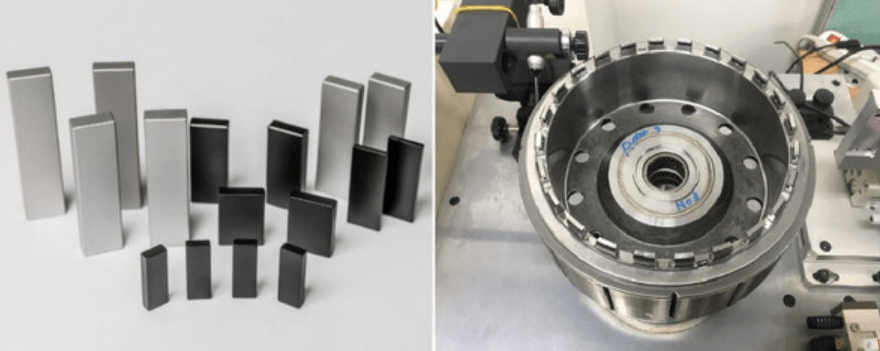
Rare earths matter because they sit inside the motors and magnets that make modern industry move.
Electric vehicles, robots, industrial motors, actuators, HDDs, wind turbines, and defense systems all rely on high-performance permanent magnets. That is why rare earths are not just another mining theme. They are a strategic materials story. And in that story, the real power lies not only in digging ore out of the ground, but in separating, refining, alloying, and turning those materials into magnets at scale.
1. The difference between light and heavy rare earths
The most important distinction in the magnet market is between light rare earths and heavy rare earths.
For motors and permanent magnets, the key light rare earths are usually neodymium and praseodymium, often grouped together as NdPr. On the heavy side, the most strategically important elements are dysprosium and terbium, or DyTb, because they are used to improve heat resistance and performance in high-end permanent magnets. That is why the magnet industry does not just care about “rare earths” in a generic sense. It cares about which rare earths are available, in what purity, and in which part of the value chain.
2. Why China is so dominant
China’s advantage is overwhelming because it controls far more than mining.
Widely cited market estimates in recent industry and policy commentary put China at roughly 59% of rare earth mining, 91% of refining, and 94% of magnet manufacturing. Those figures may vary slightly by methodology and year, but the broad message is consistent: China dominates the critical middle and downstream layers of the supply chain.
That advantage was built over decades.
China accumulated process know-how through the 1980s and 1990s, operated at scale under looser environmental constraints than many competitors, and later began treating rare earths as a strategic asset. After the Senkaku-era tensions with Japan, Beijing moved further toward tighter industry consolidation, quotas, and export controls. The end result is that China’s edge does not come from one mine. It comes from the completeness of the value chain.
3. China’s real moat is downstream process capability
China’s true moat is not just resource ownership.
It is the accumulated experience in solvent extraction, multi-stage separation, ion-adsorption clay processing, metals, alloys, and magnet manufacturing. That is much harder to replicate than simply reopening a mine. It requires time, scale, skilled operators, chemical infrastructure, and a dense industrial network that can move from oxide to finished magnet efficiently. This is why countries trying to reduce dependence on China often discover that upstream progress is easier than downstream independence.
4. America’s problem is not upstream. It is midstream and downstream
The U.S. has made real progress in rebuilding upstream supply.
MP Materials has restored the Mountain Pass mine and is now central to America’s rare earth strategy. But the deeper issue is that mining alone does not create a self-sufficient supply chain. The weak points remain separation, refining, metalmaking, and magnet manufacturing. That is exactly why U.S. policy support has increasingly shifted toward heavy rare earth separation and magnet capacity, not just ore production.
In other words, reopening a mine is only the first step.
Without the midstream and downstream layers, supply-chain independence is incomplete.
5. Why rebuilding in the U.S. is so difficult
The U.S. has already learned that rebuilding this industry is expensive and messy.
The old Molycorp story is still the best example. The company pursued large-scale capex and vertical integration, but ran into environmental costs, wastewater treatment burdens, legal problems, and heavy fixed costs. The lesson was clear: rare earths are not just a resource story. They are also a chemicals, compliance, and execution story. That is one reason why rebuilding outside China has moved more slowly than many expected.
6. The U.S. is putting money back in
Washington clearly understands that strategic materials require direct support.
Since 2017, the U.S. has steadily formalized critical minerals strategy, and the Department of Defense has moved from rhetoric to real financial backing. In 2025, MP Materials announced a major public-private partnership with the DoD that included a 10-year NdPr price floor of $110/kg, support for expanded heavy rare earth separation, and backing for a larger U.S. magnet facility. Reuters later reported that NdPr prices had already risen above that floor in early 2026.
Support has also extended beyond MP.
Lynas’s U.S. processing efforts have received DoD support as part of the broader push to create non-Chinese rare earth supply chains.
7. America’s weakest point is still heavy rare earths
This is the key strategic weakness.
Mountain Pass is primarily a light rare earth asset. But high-performance permanent magnets often need heavy rare earths, especially dysprosium and terbium, to improve temperature stability and magnetic performance. That means the U.S. can improve on NdPr and still remain vulnerable on DyTb. This is one reason heavy rare earth separation keeps showing up in DoD support packages and strategic planning.
So yes, America has rebuilt part of the chain.
But the heavy rare earth gap remains one of the clearest weak points.
8. The main alternatives are Round Top, Tanbreez, and Lynas
That is why alternative projects matter.
Round Top is often discussed as a U.S.-based option with relatively stronger heavy rare earth exposure. Tanbreez in Greenland is notable not only for rare earth potential, but also because it is a broader complex project linked to zirconium, niobium, and tantalum. And Lynas remains the most important large-scale non-Chinese rare earth player already operating at commercial scale. Reuters recently described Lynas and MP Materials as the only two companies producing rare earths at scale outside China.
The bigger point is that the non-China supply chain will likely be multipolar, not dependent on one project alone. Australia, the U.S., Greenland, Vietnam, and allied-country processing partnerships are all becoming part of the alternative map.
9. Why permanent magnets matter so much
Permanent magnet motors sit inside almost every rotating high-efficiency machine.
That includes EVs, industrial motors, servo motors, actuators, HDDs, robots, and defense systems. Within that market, NdFeB magnets are the core product. They dominate because they offer extremely high magnetic energy in a compact size, which is exactly what modern electrification and automation require.
This is why the magnet market matters even more than raw rare earth mining.
Magnets are where the industrial value becomes visible.
10. Why neodymium magnets dominate
Neodymium-based magnets dominate because they store more magnetic energy per unit volume than competing options.
That makes them ideal for small, high-power, high-efficiency motors in EVs, robots, and advanced drive systems. Their main weakness is heat sensitivity, which is why manufacturers often add dysprosium or terbium when higher thermal performance is required. That is also why heavy rare earth access matters disproportionately for premium applications.
11. Where demand is likely to grow next
Two areas stand out.
The first is data-center HDDs. As storage systems move toward higher capacity and performance, the demand for high-grade magnets remains closely tied to HDD voice-coil and spindle-motor requirements. The second is humanoids and industrial robots, where servo motors and actuators are core subsystems. As robotics scales, magnet demand rises with it because motion control is impossible without high-performance motor systems.
That is why the rare earth story is no longer just about EVs.
It is increasingly tied to data infrastructure and robotics as well.
12. Japan’s answer has been technology
Japan’s response has not been to outmine China.
It has been to reduce vulnerability through recycling, grain-boundary diffusion, hot-deformed magnets, and efforts to reduce or eliminate heavy rare earth dependence. In other words, Japan has focused on making better magnets with less strategic exposure. That is a different kind of moat, but an important one. It shows that technological process innovation can partially offset raw-material dependence, even if it cannot eliminate it entirely.
13. Korea’s challenge is still non-China diversification
Korea remains highly exposed to Chinese supply in permanent magnets.
Recent Korean media and industry reporting put Korea’s dependence on China for rare-earth permanent magnets extremely high, with one February 2026 report citing 99.3% dependence and another wave of reporting highlighting urgent efforts to build a U.S.-linked non-China supply chain.
That is why Korean companies are becoming more active.
JS Link says it already operates a permanent magnet plant in Yesan with annual capacity of 1,000 tons and sources from trusted Western and allied supply chains. POSCO International has also been pushing a U.S.-centered rare earth and permanent magnet supply-chain strategy. And Reuters reported last week that Lynas and Korea’s LS Eco Energy reached a preliminary agreement tied to rare earth processing in Vietnam and magnet manufacturing in the U.S.
So Korea’s real issue is not whether magnets matter.
It is whether Korea can secure a non-China magnet chain before geopolitical pressure intensifies further.
 The Morning Calm Notebook
댓글 남기기