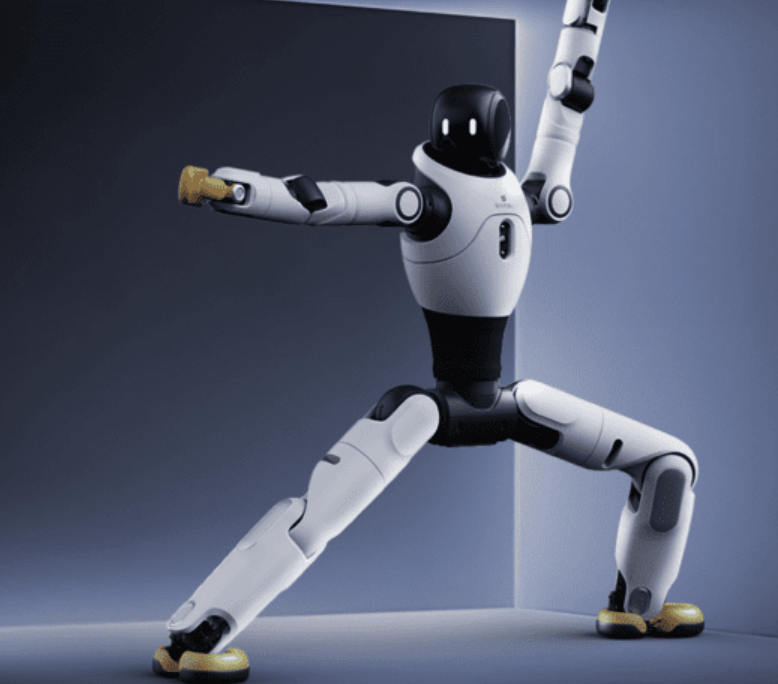
The key to the humanoid era may not be the finished robot itself.
In China’s case, the deeper advantage lies in something more fundamental: the ability to build, localize, and mass-produce the parts underneath the robot. That includes actuators, sensors, reducers, screws, magnets, dexterous-hand components, and the dense supplier ecosystem needed to scale them. This is why China’s humanoid story is not just about flashy demos. It is about whether the country can turn hardware complexity into an industrial supply chain advantage. Recent reporting suggests that is exactly what is happening.
1. Why China has the advantage
China’s biggest edge is structural.
It has a deep manufacturing base, dense supplier networks, strong localization of components, aggressive cost competition, and faster scale-up capability than most peers. Recent reporting described China’s humanoid robot companies as increasingly focused on internalizing key parts and actuators, while broader industry coverage points to a concentrated, highly active ecosystem with hundreds of players clustered in major hubs such as Beijing, Shanghai, and Shenzhen.
That is why China’s early advantage may show up first not in the polished finished product, but in the component and supply-chain layer.
2. The shift is moving from hardware to intelligence
At the beginning, the market focused mostly on hardware.
Motors, reducers, sensors, screws, and actuators were the center of attention because without them, there is no robot body to commercialize. But over time, the competitive edge broadens. The next layer includes perception, planning, decision-making, action control, and the accumulation of operational data. Industry reports on humanoids now treat not only electromechanical hardware but also software, AI, and data as essential parts of the value chain.
In other words, winning in humanoids will ultimately require more than hardware.
It will require a full stack that combines parts, software, and data.
3. Even so, the money may come to components first
Before humanoids become mainstream, costs have to come down.
That is why the component layer matters so much. Elon Musk has repeatedly framed Tesla Optimus around a long-term target price of roughly $20,000 to $30,000, and that range has become a reference point for the whole industry. If humanoids are ever going to approach that level at scale, the cost of the core parts has to fall materially.
That is why the first major beneficiaries may not be only the OEMs.
They may also be the suppliers of actuators, reducers, screws, magnets, and sensors that sit closest to the bill of materials.
4. The real center of the humanoid BOM is motion and perception
Exact cost shares vary by design, but the broad structure is clear.
Industry research shows that joint actuators alone typically account for more than 30% of humanoid BOM cost, and in simpler robots the share can be even higher. Other reports also treat sensors, reducers, screws, batteries, and dexterous hands as major value contributors.
That tells you something important.
The humanoid BOM is not dominated by one glamorous end product. It is built around two practical cost centers: motion and perception.
5. Why actuators matter most
Actuators are the real muscles of a robot.
They are what actually move the joints, control force, and turn software commands into physical action. That is why so much of the hardware value concentrates there. In China’s supply chain, companies such as Tuopu Group and Sanhua Intelligent Controls are often discussed as key names tied to actuator-related opportunities. Recent coverage noted that Tuopu’s robotics actuator business is still small in revenue terms, but already carries a meaningfully higher gross margin than its core auto-parts business.
That makes actuators one of the first places where humanoid economics can show up in earnings.
6. Screws and reducers matter more than they look
As humanoids become more capable, the number and complexity of joints rise.
That pushes up demand for screws in linear motion systems and reducers in rotary joints. Industry research consistently treats both as core subcomponents within the humanoid value chain, alongside motors and bearings.
This matters because reducers affect precision and durability, while screws can be high-value components in systems that require controlled linear movement. And humanoids generally need more joints and more dexterity than traditional industrial robots, which means these parts can become meaningful bottlenecks once mass production begins.
7. Dexterous hands are a high-value layer
The industrial value of a humanoid may ultimately depend on its hands.
A dexterous hand determines whether the robot can use tools, manipulate irregular objects, and expand from simple motion into real work. That is why this category is strategically important even if it is smaller in volume than the main joint systems. Zhaowei Machinery & Electronics has been active in this area, and the company publicly showcased a dexterous hand with independent finger control and force feedback at CES 2025. Separate reporting in 2025 also said Zhaowei supplies Tesla with micro-precision transmission components used in Optimus dexterous hands.
So while hands may not be the first driver of mass adoption, they could become one of the biggest drivers of high-end differentiation.
8. Sensors are just as critical as actuators
A humanoid without good sensing is just a moving frame.
Encoders, force-torque sensors, tactile sensors, vision sensors, and IMUs all matter because they allow the robot to know where it is, what it is touching, how much force it is applying, and how to adjust in real time. Market research consistently includes sensors as one of the key component families in humanoid BOM analysis.
That is why sensors should not be treated as a secondary afterthought.
In many applications, they are as important as the actuator itself because they determine whether the robot can operate safely, accurately, and repeatedly in real environments.
9. The key names in the Chinese humanoid supply chain
If you map the supply chain, several names keep showing up.
For actuators, investors often watch Tuopu Group and Sanhua Intelligent Controls. For reducers, Shuanghuan Driveline is frequently mentioned in industry mapping. For rare-earth magnets, JL MAG Rare-Earth has explicitly discussed humanoid robot motor rotors and related magnetic components in recent filings. For dexterous hands, Zhaowei Machinery & Electronics is one of the most visible names. And for full-stack humanoid OEM exposure, UBTech remains one of the clearest Chinese listed names, with industry reports noting deployments or pilots at BYD, Nio, and Zeekr.
That is the deeper point.
The humanoid opportunity in China is not just one stock or one robot.
It is a multi-layer industrial chain, and in the early phase, the component suppliers may matter just as much as the OEMs.
 The Morning Calm Notebook
댓글 남기기