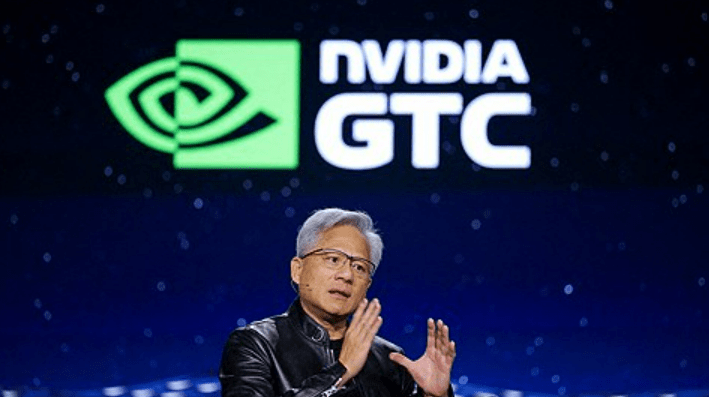
NVIDIA’s message at GTC 2026 was bigger than GPU performance.
Yes, the company talked about faster chips, better inference efficiency, and lower cost per token. But the real shift was strategic. NVIDIA is increasingly positioning itself not as a semiconductor vendor, but as the architect of the full AI production stack — from compute and networking to storage, orchestration, and the software layer that keeps the entire system running. That is why the company now looks less like a chipmaker and more like an AI infrastructure company.
1. The real message of GTC 2026
The most important takeaway from GTC 2026 was not a single chip spec.
It was the idea that AI is now being sold as an integrated factory system. NVIDIA’s official announcement described the Vera Rubin platform as seven new chips in full production, organized into five rack-scale systems, designed to work together as one AI supercomputer. That is a very different message from simply launching a faster GPU. It means NVIDIA is now selling the entire structure of AI infrastructure.
In other words, the company is moving beyond the old “buy a chip, build the rest yourself” model. It is increasingly offering a full-stack architecture optimized for every phase of AI, from pretraining and post-training to test-time scaling and agentic inference.
2. The era of heterogeneous systems has begun
This is no longer a GPU-only story.
According to NVIDIA, the Vera Rubin platform brings together the Vera CPU, Rubin GPU, NVLink 6 switch, ConnectX-9 SuperNIC, BlueField-4 DPU, Spectrum-6 Ethernet switch, and the newly integrated Groq 3 LPU. These chips are then organized across rack-scale systems including Vera Rubin NVL72 GPU racks, Vera CPU racks, Groq 3 LPX inference accelerator racks, BlueField-4 STX storage racks, and Spectrum-6 SPX Ethernet racks.
That matters because the future of AI infrastructure is becoming purpose-built rather than uniform.
Instead of relying on one general-purpose processor for everything, NVIDIA is designing an AI factory where each function is assigned to the part of the system best suited to it. The product being sold is no longer a component. It is the whole factory configured around a workload.
3. The center of gravity is shifting from training to inference
Another major change is where value is being measured.
As agentic AI expands, the key question is no longer just how large a model can be trained. It is how many tokens can be produced, how fast they can be delivered, and how efficiently the system can do it at scale. NVIDIA’s own product messaging around both Blackwell Ultra and Vera Rubin increasingly focuses on inference economics, token cost, and throughput per watt rather than training performance alone.
That is a major shift.
In the agentic era, the winners may be defined less by raw training power and more by who can run inference at the best balance of speed, latency, and power efficiency.
4. Why Vera Rubin matters
Rubin is still the heart of the system.
But the key point is that NVIDIA is no longer presenting Rubin as a standalone GPU story. It is presenting Vera Rubin NVL72 as the core compute engine of a larger AI factory. NVIDIA says the rack integrates 72 Rubin GPUs and 36 Vera CPUs connected by NVLink 6, and that it delivers up to 4x better training performance and up to 10x better inference performance per watt relative to Blackwell, while cutting token cost to one-tenth.
That makes Rubin more than a new accelerator.
It is the engine room of NVIDIA’s AI factory model.
5. Why the Vera CPU matters more than many people think
The rise of agentic AI is also making the CPU more important again.
NVIDIA’s own explanation is revealing. The company says that as reasoning and agentic AI advance, performance and cost are increasingly driven by systems that plan tasks, run tools, interact with data, run code, and validate results. Those are exactly the kinds of workloads where the CPU plays a much larger role than many people expected during the pure GPU boom.
That is why NVIDIA launched Vera as the first CPU purpose-built for the age of agentic AI and reinforcement learning. The company says Vera delivers twice the efficiency and is 50% faster than traditional rack-scale CPUs, while also positioning it as critical infrastructure for large-scale AI services and agentic workloads.
In short, the agentic AI era does not reduce CPU importance.
It raises it.
6. Dynamo may be the real moat
If the hardware defines the factory, Dynamo may define the operating logic.
NVIDIA describes Dynamo 1.0 as the distributed “operating system” of AI factories, coordinating GPU and memory resources across the cluster to support large-scale generative and agentic inference. The company says Dynamo 1.0 can boost inference performance on Blackwell GPUs by up to 7x, while integrating into widely used open-source frameworks such as LangChain, SGLang, vLLM, LMCache, and others.
This is strategically important.
Once NVIDIA owns not just the chip, but also the orchestration layer that decides how work moves across the cluster, it becomes much harder to compete with the company at the infrastructure level. That is when NVIDIA starts to look less like a component vendor and more like an infrastructure platform with an operating system.
7. What the LPX plus Rubin combination is really saying
One of the more interesting signals from the new platform is that NVIDIA is explicitly embracing specialization inside inference.
NVIDIA says Groq 3 LPX is co-designed with the Vera Rubin platform for the long-context and low-latency demands of agentic AI, using 256 LPUs per rack. The company says that combining LPX with Vera Rubin NVL72 can deliver up to 35x more tokens and up to 10x more revenue opportunity for trillion-parameter models relative to Blackwell.
The strategic meaning is bigger than the product itself.
It suggests NVIDIA no longer believes one processor type should do everything. In premium inference, especially where interactivity and long context matter, the company is moving toward a more specialized architecture where different silicon handles different bottlenecks.
8. Optical networking and CPO are part of the same story
As AI factories scale, networking becomes the next major bottleneck.
That is why NVIDIA has also been investing aggressively in photonics and co-packaged optics. In 2025, the company announced Spectrum-X Photonics and Quantum-X Photonics, saying these switches would deliver 3.5x energy savings, improved signal integrity, and dramatically better resilience at scale for AI factories that may eventually connect millions of GPUs. NVIDIA also said integrating silicon photonics directly into switches helps overcome the physical limits of older hyperscale network designs.
So the networking message is consistent with the rest of the platform strategy.
If NVIDIA is going to sell the whole AI factory, it cannot stop at compute. It also has to own the fabric that keeps the factory connected.
9. NVIDIA’s endgame is much bigger than GPUs
The broader picture is now hard to miss.
NVIDIA is evolving from a GPU company into a company that combines GPU, CPU, LPU, networking, storage, orchestration software, and full AI factory architecture into a single platform. Even its public language increasingly reflects that shift, with repeated references to AI factories, rack-scale systems, POD-scale deployments, and the infrastructure required for agentic AI.
That is the real story.
NVIDIA is not just selling hardware for intelligence.
It is trying to own the infrastructure that produces intelligence.
 The Morning Calm Notebook
댓글 남기기