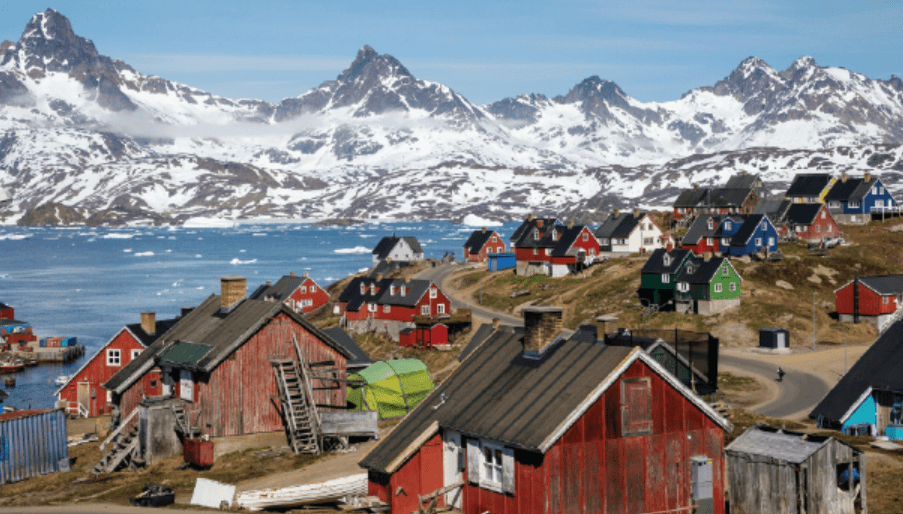
For decades, Greenland was viewed as a remote, icy frontier. But as we move into 2026, the island has been thrust into the center of a high-stakes geopolitical tug-of-war. This isn’t just about territory; it’s about a direct response to two of the West’s most glaring structural vulnerabilities: Russia’s grip on Arctic shipping and China’s dominance over rare earth elements.
Greenland is no longer just an island; it is the intersection where logistics, resources, and power politics collide.
1. Breaking the Polar Monopoly: The New Shipping Frontier
The Arctic is home to three major routes, but today, the narrative is dominated by Russia’s Northern Sea Route (NSR). With nearly 90 transit voyages annually and massive LNG shipments from the Yamal project, Russia effectively controls the gateway.
However, as ice continues to recede, the Transpolar Sea Route (TSR)—which cuts through international waters—is becoming a viable future corridor. Greenland sits at the very edge of this emerging highway. For the U.S. and its allies, Greenland represents the essential “chokepoint” to ensure that the future of global trade isn’t dictated solely by Moscow.
2. The Rare Earth Bottleneck: Beyond Mining
While the world talks about “mining” rare earths, the real crisis is refining. China currently controls roughly 90% of global refining and magnet production. Greenland’s untapped deposits are now viewed as a “must-have” to break this dependency.
- Tanbreez Project: With a 27% heavy rare earth content and minimal uranium complications, this is the West’s most pragmatic shot at a non-Chinese supply chain by 2028.
- Kvanefjeld: Despite political and environmental hurdles, its sheer scale keeps it on the global radar as a high-stakes strategic asset.
3. The ICE Pact: A $14 Billion Opportunity for Shipbuilding
If the Arctic opens, the world needs a specific tool: Icebreakers. The newly formed ICE Pact (U.S., Finland, Canada) aims to build 70 to 90 icebreakers over the next decade.
With a projected market gap of 40–50 vessels worth roughly $14 billion, the eyes of the world are turning toward South Korea’s shipbuilding titans. HD Hyundai Heavy Industries, Hanwha Ocean, and Samsung Heavy Industries possess the unique “cold-environment engineering” and LNG propulsion expertise required for these high-spec vessels. For Korea, the opening of Greenland is a massive industrial tailwind.
4. Undiscovered Wealth: The Energy Dimension
The U.S. Geological Survey (USGS) estimates that the Arctic holds 360 billion barrels of oil equivalent. Specifically, the basin between West Greenland and East Canada could hold up to 7.8 billion barrels of recoverable oil. While extraction remains early-stage, the mere existence of these resources elevates Greenland from a remote island to a “strategic energy reserve” for the West.
The Bottom Line
Greenland matters because it is the only place on Earth where logistics, minerals, and energy converge to solve the West’s most pressing security dilemmas. As the ice thins, the island’s importance only thickens. We are witnessing the transformation of Greenland from a geographical footnote into a cornerstone of 21st-century global infrastructure.
 The Morning Calm Notebook
댓글 남기기