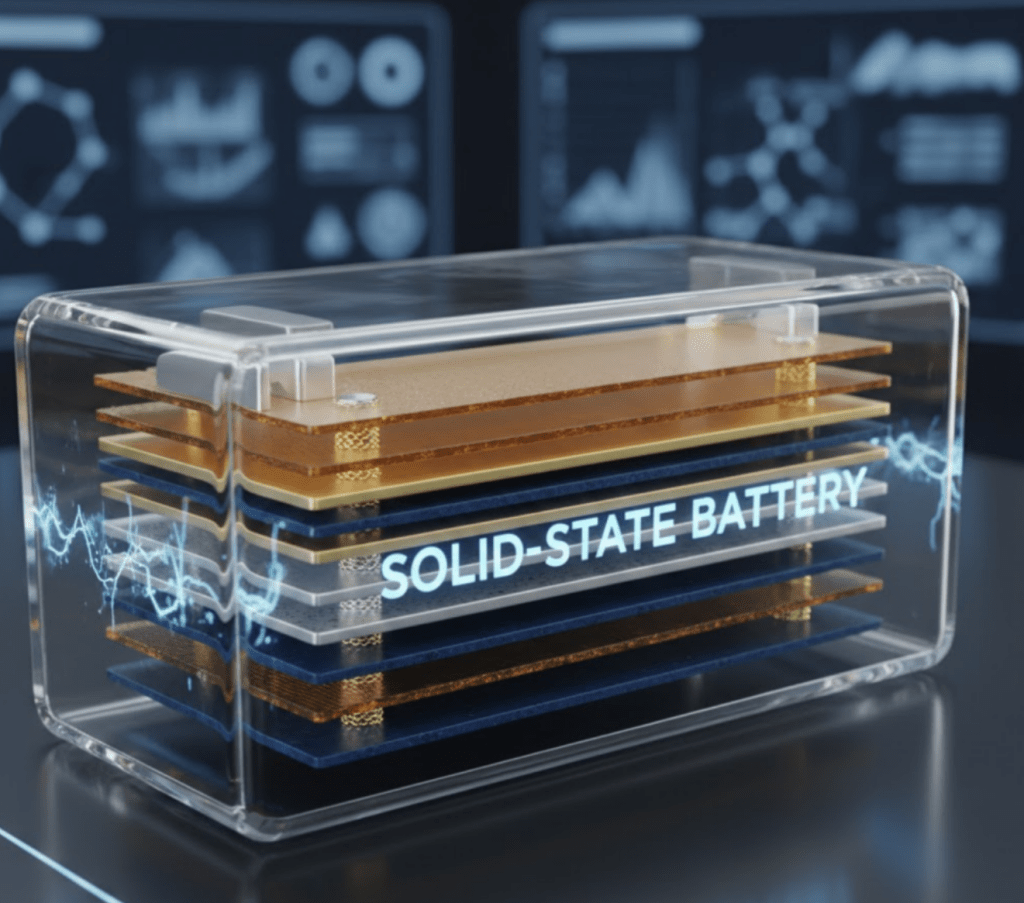
For over a decade, solid-state batteries (SSBs) have been the “perpetual next big thing”—always five years away. But as we enter 2026, the hype cycle is undergoing a structural shift. The conversation has moved from “When can they replace Lithium-ion?” to “Which high-value sectors will they dominate first?” The story this time isn’t just about better chemistry; it’s about the emergence of new markets—Humanoid Robots and Defense—where the economics of solid-state actually make sense.
1. The Architecture of Performance: Beyond the Liquid Limit
The fundamental shift from liquid to solid electrolytes isn’t just a safety upgrade; it’s a performance unlock. By removing the flammable liquid, we achieve:
- Energy Density Frontier: SSBs target 450–500 Wh/kg, nearly doubling the ceiling of current Li-ion (250–300 Wh/kg).
- Thermal Integrity: Fire risk is virtually eliminated, and the need for complex cooling systems is reduced, allowing for more compact packs.
- The 10,000 Cycle Milestone: With potential life cycles reaching 8,000 to 10,000 charges, SSBs offer a longevity that justifies their premium price tag in industrial applications.
2. The Humanoid Catalyst: A Match Made in Robotics
While EVs struggle with the $400–$600/kWh price tag of early SSBs, the robotics industry has different priorities. Humanoid robots, projected to reach 6.79 million units by 2035, operate under extreme space constraints and require high power-to-weight ratios. By 2040, nearly 68% of humanoid robot batteries could be solid-state. Why? Because in robotics, safety and durability in human-centric environments are more critical than absolute cost-per-kWh.
3. Defense and Aerospace: The Strategic High-Ground
Military drones and aerospace systems require energy densities (400–600 Wh/kg) that traditional batteries simply cannot reach. In 2026, geopolitical supply chain concerns are pushing Western and Allied defense sectors toward SSB technology as a way to decouple from existing supply chains while gaining a tactical edge in flight endurance and reliability.
4. The Commercial Roadmap: 2026–2030
We are seeing a fierce race for pilot production. While mass market penetration will remain niche (projected at ~6.1% by 2035), the leaders are establishing their footprints:
- Samsung SDI: Aggressively targeting sulfide-based production by 2027.
- LG Energy Solution & SK On: Aligning targets between 2029 and 2030.
- Global Players: Toyota and CATL are both eyeing 2027 for pilot-scale applications.
The bottleneck remains Lithium Sulfide (Li₂S) and specialized sulfide-based electrolytes. Companies that control this supply chain will be the gatekeepers of the solid-state era.
The Bottom Line
Solid-state batteries won’t kill Lithium-ion overnight. Instead, they are carving out a high-tier “Strategic Infrastructure” segment. In the AI and Robotics era, the bottleneck isn’t just energy; it’s energy density per square inch. As costs decline through specialized adoption in robotics and defense, the path to premium EVs will finally clear. We aren’t just watching a battery evolve; we’re watching the birth of a new energy tier.
 The Morning Calm Notebook
댓글 남기기