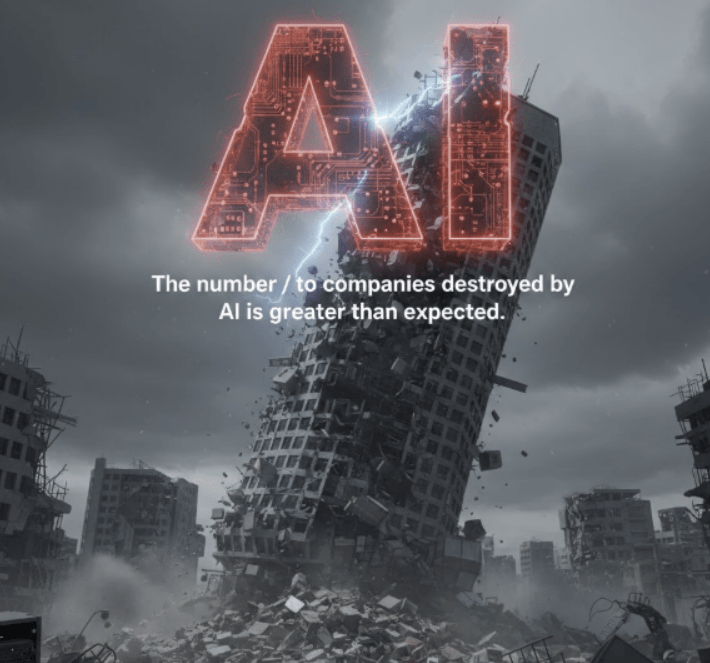
Markets are finally waking up to an uncomfortable reality: AI isn’t just a productivity booster. It’s a structural wrecking ball.
We’re seeing this play out in logistics right now. A recent white paper from an AI-driven freight platform sent shockwaves through the sector with some aggressive claims: 70% reduction in empty miles and a 400% increase in throughput—all without adding a single human to the payroll.
This isn’t “incremental improvement.” It’s structural replacement.
Why the “Safe” Industries are at Risk We used to think AI was only coming for SaaS, coding, and graphic design. We were wrong. AI is targeting industries defined by fragmentation and manual friction. Logistics is the perfect victim: phone-call-heavy brokerage, disconnected data, and massive underutilization of assets.
From Evolution to Replacement In the old world, you had transport companies using IT tools. In the new world, you have an AI platform managing a truck network. Traditional firms risk becoming replaceable nodes rather than core operators.
The Takeaway: AI doesn’t just create winners and losers; it compresses industries. 100 companies become 20. Intermediaries vanish. If your business model is built on managing “inefficiency,” your margin is now someone else’s opportunity. The shift won’t be a slow evolution—it will be a total replacement.
Option 2: The “Deep Dive” Analyst Style (Narrative & Flowing)
Best for: A long-form WordPress post that feels like a newsletter (e.g., Stratechery style).
Title: Beyond the Hype: AI and the End of the Middleman
For a long time, the bull case for AI was simple: workers get faster, and profits go up. But the market is starting to realize a darker truth. AI is restructuring the “Physical Economy”—logistics, manufacturing, and energy—in a way that leaves no room for the traditional incumbents.
Take the logistics chain. It has always been a messy web of shippers, brokers, and dispatchers. It’s a system held together by manual scheduling and “gut feeling.”
When an AI-driven system enters this space, it doesn’t just help the broker; it obviates the broker. By automating demand matching and pricing in real-time, the same number of trucks can move four times the cargo. The revenue pool doesn’t grow—it gets redistributed to the platform that owns the intelligence.
Structural Weakness Meets Algorithmic Power AI is moving into the “messy” industries:
- Logistics: Zeroing out empty runs.
- Agriculture & Energy: Optimizing fragmented data.
- Finance: Removing layers of manual validation.
We are entering an era of Industry Compression. We’re moving from labor-heavy processes to platform consolidation. The question for every CEO right now shouldn’t be “How do we use AI?” but rather “Does our industry even need to exist in its current form?”
Option 3: The “Contrarian” Punchy Style (Short & Viral)
Best for: Grabbing attention quickly with bold headers.
Title: AI Isn’t Improving Your Company—It’s Replacing Your Industry
The market just got a wake-up call. AI isn’t a software upgrade; it’s a structural reset.
1. The Logistics Canary in the Coal Mine New AI platforms are hitting 400% throughput increases while cutting waste by 70%. This isn’t a better “tool” for trucking companies. It’s a new system that makes traditional trucking companies optional.
2. The Compression Effect Most tech shifts create competition. AI creates compression.
- 100 players → 5 dominant platforms.
- Manual layers → Automated code.
- High margins → Brutal pricing pressure.
3. The Physical Shift This isn’t just about ChatGPT or Midjourney. AI is eating the physical economy—logistics, construction, and manufacturing. Anywhere there is fragmented data and “middleman” friction, AI is coming to simplify it out of existence.
The Bottom Line: The shift won’t look like evolution. It will look like a liquidation. If your value is based on navigating “inefficiency,” your clock is ticking.
 The Morning Calm Notebook
댓글 남기기