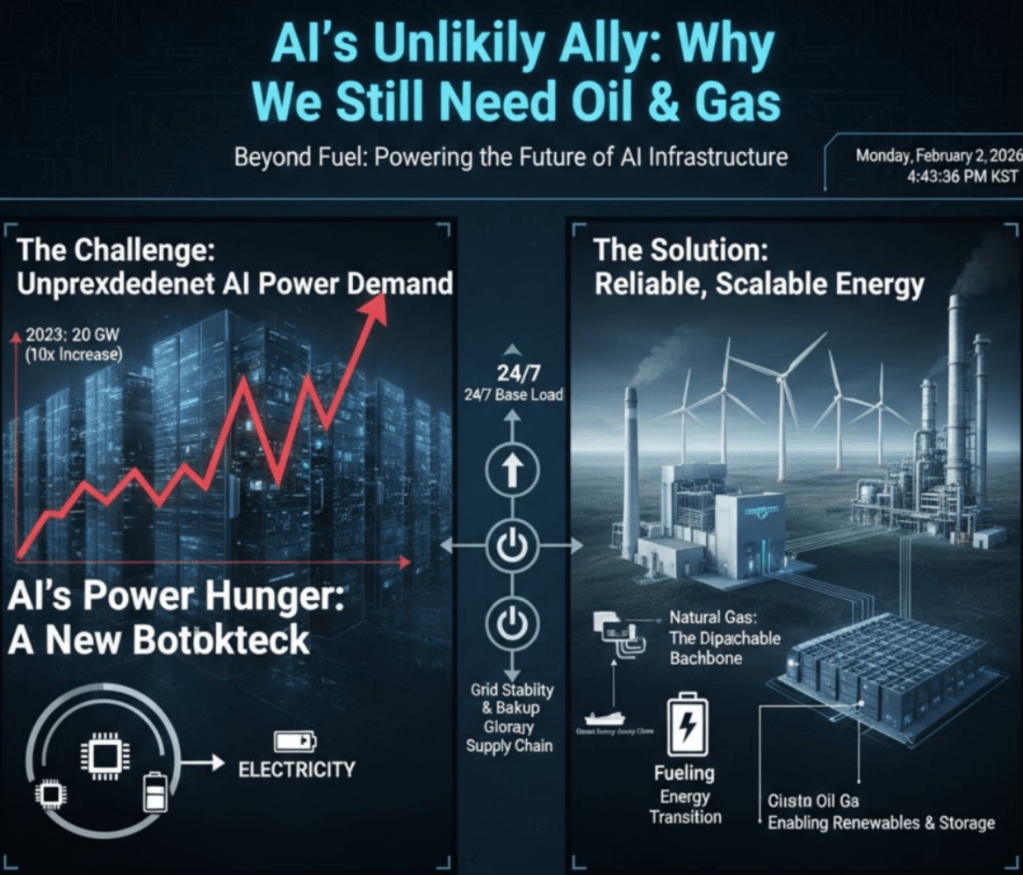
We are often told that Artificial Intelligence is a digital revolution. But in the physical world, AI is quickly becoming one of the most power-intensive industrial shifts in human history.
The narrative is shifting. AI is no longer just a “software story”—it is a power story. And that changes the fundamental role of traditional energy companies from legacy polluters to essential infrastructure providers.
1. AI is a Physical Industry
Hyperscale data centers and massive GPU clusters don’t just need “electricity”; they need constant, high-density energy. As large language models (LLMs) and real-time vision applications expand, demand doesn’t grow linearly—it compounds.
In this new reality, electricity has become the binding constraint on innovation. If you can’t power the chips, the code doesn’t matter.
2. The Limits of “Green-Only” Infrastructure
While the world wants a renewable future, AI infrastructure faces a cold reality: volatility.
- Solar and wind are weather-dependent.
- Storage costs remain high at the scales AI requires.
- AI needs 24/7, “always-on” uptime.
“Mostly available” power is a non-starter for a global data center. This is why Big Tech and governments are pivoting back to base-load power—energy that is instantly dispatchable and infinitely scalable.
3. Natural Gas: The Core, Not the Bridge
Natural gas has moved from being a “bridge fuel” to becoming core AI infrastructure. Its ability to ramp up and down instantly makes it the perfect partner for fluctuating renewable grids.
The industry’s heavyweights have already seen the writing on the wall:
- ExxonMobil and Chevron are aggressively developing gas-fired power projects specifically to sit alongside AI hubs.
- Saudi Aramco has entered the LNG value chain for the first time in its history.The messaging has shifted from “energy transition” to “energy security.”
4. Quality Over Quantity: The Hybrid Architecture
AI workloads demand more than just raw megawatts; they require power quality. This means voltage stability, frequency control, and instant peak response—things that batteries alone cannot yet provide at scale.
The new default architecture for the AI era is a Hybrid System:
Gas + Renewables + Batteries
This isn’t an ideological choice; it’s a technical necessity for reliability.
5. From Commodity Sellers to Energy Platforms
Modern energy majors are evolving. They are no longer just “oil companies.” They are becoming integrated platforms that manage:
- LNG Trading & Power Generation
- Grid Infrastructure & Energy Storage
- CCS (Carbon Capture & Storage)
SK Innovation is a prime example of this evolution. By combining refining, chemicals, LNG, and power generation (via E&S) with carbon capture initiatives, it has built the exact integrated structure that the AI era favors. They are becoming system operators, not just commodity sellers.
The New Energy Hierarchy
| Power Source | Role in AI Era | The “Reality Check” |
| Renewables | Green footprint | Intermittent; requires massive land. |
| Batteries | Short-term smoothing | High cost; limited long-duration capacity. |
| Natural Gas | The Stabilizer | Instant dispatchability; core base-load. |
| Nuclear | Long-term base-load | High CAPEX; long regulatory lead times. |
The Final Takeaway: Energy is Strategic Again
There is an uncomfortable truth: AI makes the green transition harder, not easier. Explosive power demand leads to higher gas reliance, which increases carbon pressure. Managing this trade-off requires massive capital, advanced technology, and physical infrastructure.
The AI era isn’t making oil and gas companies obsolete. It is redefining why they are indispensable. They are the only entities capable of delivering the high-quality, reliable power at the scale the silicon revolution demands.
AI does not run on code alone. It runs on energy—and once again, energy is the ultimate strategic asset.
 The Morning Calm Notebook
댓글 남기기