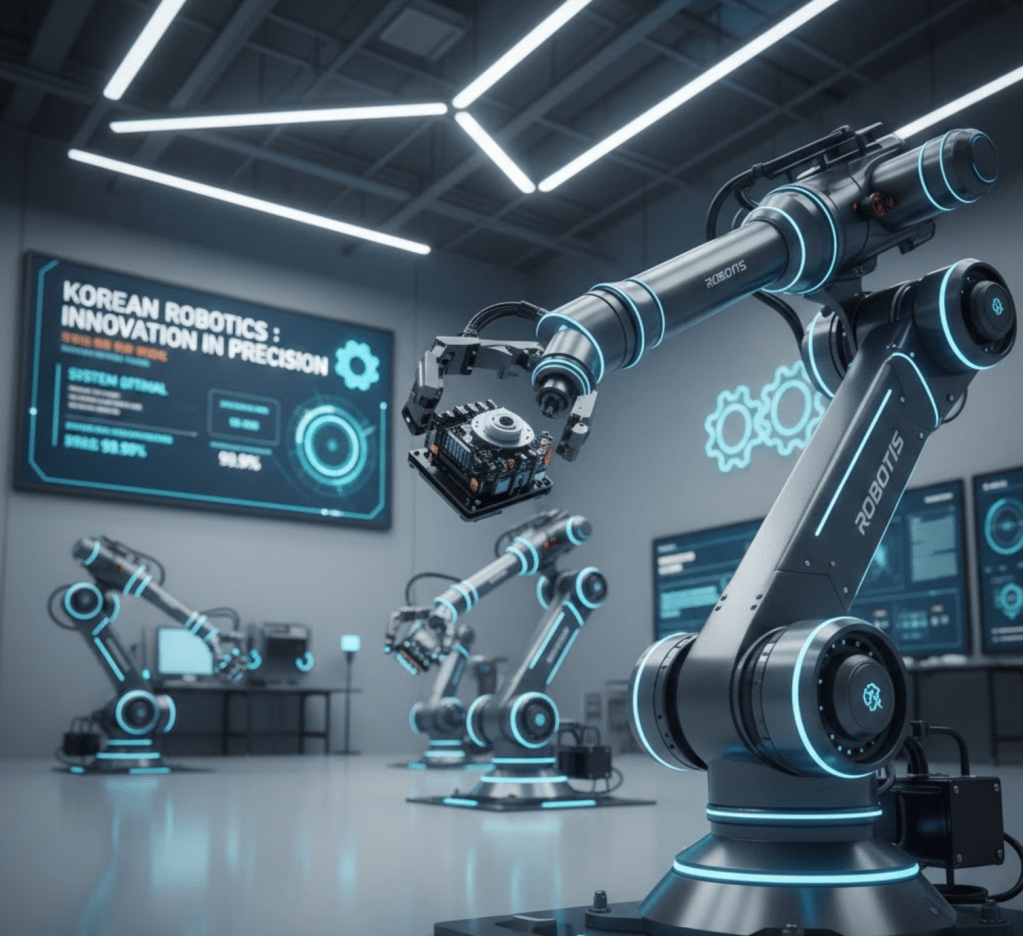
South Korea is often overlooked in the global robotics conversation, sandwiched between China’s massive scale and Japan’s decades of precision dominance. If you look at the macro value chain, Korea doesn’t dominate. But looking at the “big picture” often causes people to miss the “small parts” that actually make the world move.
Korea’s real strength isn’t in volume; it’s in a narrow, technical, and experience-driven “Middle Ground.” It is a strategy of defensible niches.
1. The Reducer Battle: Chasing the Heart of Motion
The harmonic reducer is arguably the hardest mechanical hurdle in robotics. While Japan has long held the crown here, SBB TECH is leading Korea’s charge to localize this critical component.
They aren’t just a “cheaper alternative.” By working in a tight feedback loop with domestic OEMs, they are steadily closing the quality gap. In a world where supply chains are increasingly fragile, SBB TECH’s ability to improve yield and durability represents a strategic hedge for the entire industry.
2. The Sweet Spot of Precision Machining
Precision isn’t just a design problem; it’s a manufacturing one. This is where SPG thrives. They occupy a distinct competitive space:
- More reliable than the mass-produced, low-cost components coming out of China.
- More cost-efficient than the ultra-premium players in Japan.
For many industrial applications, “ultra-premium” is overkill, but “cheap” is a liability. Korea’s machining sector provides exactly what the market needs: high-tier reliability without the prohibitive price tag.
3. Intelligence Through Integration: Neuromeka & ROBOTIS
A sensor is only as good as the software that filters its noise. Neuromeka has carved out a position not by selling parts, but by mastering the complexity of hardware-software co-design. Their focus on collaborative robots (cobots) and real-time control loops proves that in robotics, experience compounds faster than volume.
Similarly, ROBOTIS has shifted the value proposition from individual parts to modular actuators. By integrating sensing and control at the module level, they simplify the “robot-to-PLC” communication that often plagues factory deployments. They aren’t just selling a motor; they’re selling a system that works out of the box.
4. The Infrastructure Anchor: LS Electric & Hyundai WIA
Robots don’t exist in a vacuum; they live on factory floors. This is where Korea’s industrial giants provide a massive “home-court” advantage.
- LS Electric bridges the gap between robotics and power infrastructure.
- Hyundai WIA leverages deep expertise in automation equipment to provide the upstream reliability that pure-play startups lack.
These aren’t just robot companies—they are the ecosystem builders that ensure the robots actually have a place to work.
Summary: The Korean Advantage
| Segment | The Strategic Value | The “Korean Edge” |
| Precision Reducers | The “muscles” of motion | Closing the Japan gap; superior to low-tier alternatives. |
| Precision Machining | Mechanical longevity | The “Goldilocks” zone of cost vs. quality. |
| Control Systems | Intelligence and safety | Deep HW-SW integration; noise-resilient sensing. |
| Actuator Modules | Ease of deployment | Modular, self-calibrating systems. |
| Industrial Infra | Scale and reliability | Decades of factory automation “DNA.” |
The Final Takeaway
Korea isn’t trying to out-scale China, and it isn’t trying to out-legacy Japan. Instead, it thrives where failure is expensive and precision is non-negotiable.
These may be smaller, more technical markets, but they are incredibly defensible. In the long run, the most durable value in robotics isn’t found in the flashiest machines, but in the precision components that make those machines possible.
 The Morning Calm Notebook
댓글 남기기