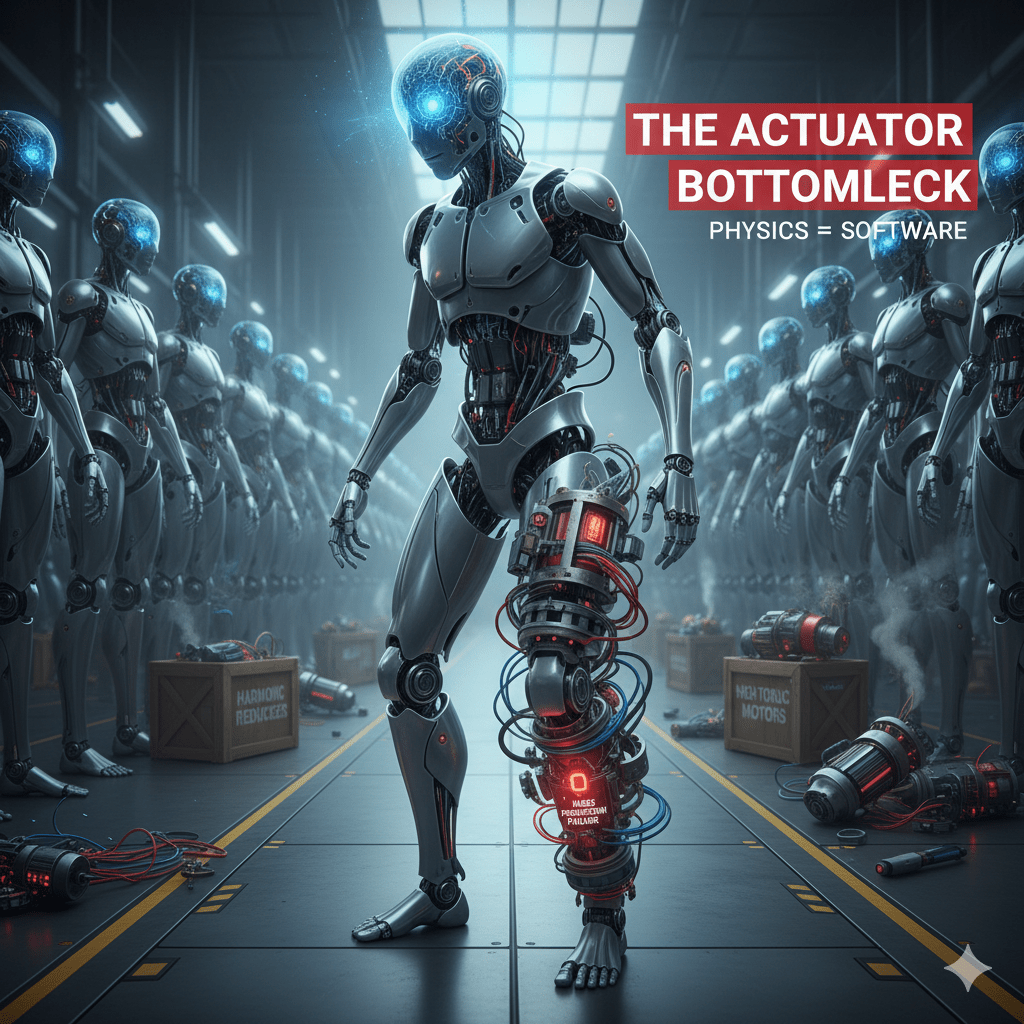
As humanoid robots transition from polished YouTube demos to real-world deployment, a harsh reality is setting in. The industry is hitting a wall, and it isn’t the one most people expected.
It isn’t a lack of data. It’s not a flaw in the LLM. It isn’t even the software.
The bottleneck is the actuator.
1. Where the Road Ends: The Integration Point
In high-performance robotics, the “moment of truth” happens where the reducer, motor, and controller meet. Unlike the digital world, this domain isn’t governed by elegant algorithms or massive datasets.
Instead, it is dominated by the stubborn laws of manufacturing physics:
- Material Behavior: How metal flexes under stress.
- Precision Machining: The literal microns of a gear’s tooth profile.
- Heat Treatment: Mastering the durability of the metal itself.
In short: This is a hardware physics problem that you cannot “code” your way out of.
2. Why Actuator Barriers are Built Different
Physics Offers No Shortcuts
You can optimize a piece of software until it’s perfect, but actuators must obey the unyielding laws of torque, friction, and fatigue. A humanoid robot needs to walk like a human and stop like a human, all while resisting the mechanical fatigue that leads to catastrophic failure. No simulation can perfectly replicate the real-world shock of a robot’s foot hitting concrete thousands of times a day.
The “Impossible” Triple Constraint
Building a great actuator means solving four conflicting goals simultaneously:
- Ultra Precision: Zero “slop” (backlash) in the movement.
- High Durability: Lasting through tens of millions of cycles.
- Compact Form Factor: Fitting all that power into a human-sized limb.
- Mass Producibility: Being able to make 100,000 units without the quality dropping.
Solving for one is a science project. Solving for all four is an industrial miracle.
3. The “Big Three” Bottleneck Components
If you want to know who will win the humanoid race, look at who controls these three components:
1: Harmonic Reducers (The Precision King)
These are the most critical joints in a humanoid. They offer zero backlash but are notoriously difficult to manufacture. Because production is slow and defect rates are high, harmonic reducers are almost always the first part to go into a shortage when demand spikes. It’s why Japanese firms dominated for decades—this is an industry built on “accumulated experience,” not just capital.
2: High-Density Motors
A robot doesn’t just spin; it spends much of its life holding a position or making micro-movements. This requires extreme thermal management in a tiny package. If the motor and reducer aren’t perfectly matched, the robot simply cannot walk.
3: Encoders and Force Sensors
In a humanoid, sensing is binary. A tiny error in position leads to immediate instability; a failure in force-sensing leads to structural damage. At this scale, there is no room for “good enough.”
4. The Scale Trap
We see a consistent pattern in robotics startups:
- The Demo works (The robot looks great on video).
- Small-batch production succeeds.
- Mass production fails.
At the scaling stage, the AI works, and the cloud is ready, but the actuators fail to scale. The result isn’t a “software bug”—it’s a component shortage that brings the entire production line to a halt.
Final Thought: The Value is in the Motion
The humanoid revolution won’t slow down because our AI isn’t smart enough. It will slow down because our hardware cannot be industrialized at the same speed as our code.
Actuators sit at the brutal intersection of physics and precision manufacturing. That makes them the ultimate bottleneck—and the most valuable, defensible position in the entire robotics value chain.
 The Morning Calm Notebook
댓글 남기기