In the world of robotics, intelligence gets the headlines, but motion defines reality.
We are currently witnessing a paradox: while AI “brains” are evolving at exponential speeds, the physical “bodies” of robots are struggling to keep up. As we move toward a future of humanoids and seamless human-robot collaboration, it’s becoming clear that intelligence alone does not create movement. The true bottleneck in robotics today isn’t just data or sensors—it’s the actuator.
1. The Muscle Behind the Machine
In simple terms, an actuator is a robot’s muscle. It is the sophisticated system that converts electrical energy into controlled, physical motion. Whether it’s the delicate touch of a robotic hand or the steady stride of a humanoid, the actuator determines how strong, precise, and safe a robot can be.
No matter how advanced an AI model is, if the actuators are subpar, the robot remains clumsy and inefficient.
2. More Than a Motor: An Integrated System
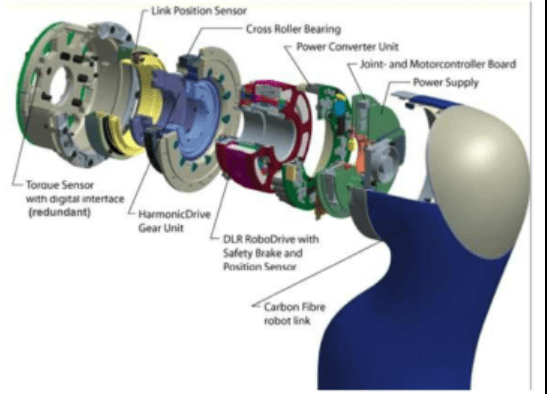
A common misconception is that an actuator is just a motor. In reality, modern robotics requires a tightly integrated motion system consisting of four critical pillars:
- The Motor: The power source converting electricity to force.
- The Reducer (Gearbox): The “torque amplifier” that sacrifices speed for precision and strength.
- Sensors & Encoders: The “nerve endings” that detect position and force.
- The Controller: The “local brain” that regulates current and motion in real-time.
The real engineering challenge today isn’t just building these parts—it’s miniaturizing and integrating them into a single, high-performance unit.
3. Why the Stakes Have Changed
Why are we talking about actuators now more than ever? Two words: Humanoids and Collaboration.
Previously, industrial robots lived behind safety cages. They were heavy, rigid, and dangerous. But today’s AI-driven robots must move alongside humans. This requires:
- Backdrivability: The ability for a robot to respond “softly” when pushed, ensuring human safety.
- Fine-Grained Control: High-speed adjustments to maintain balance under variable loads.
- Extreme Miniaturization: Cramming immense power into a limb the size of a human arm.
4. The “Reducer” Battleground
If the actuator is the muscle, the reducer (gearbox) is its most critical ligament. As we shift toward humanoid forms, one technology has become the “Holy Grail”: The Harmonic Drive.
Unlike standard gears, Harmonic Drives offer ultra-high precision with near-zero “backlash” (slop in the gears). While RV Reducers remain the kings of heavy-duty industrial lifting, the growth of the humanoid market is making high-precision harmonic drives the strategic core of the supply chain.
5. A Market on the Verge of Explosion
The numbers tell a staggering story. The humanoid robot actuator market is projected to skyrocket:
- 2024: $150 Million
- 2031: $9.86 Billion
- Compound Annual Growth Rate (CAGR): ~80%
We are looking at one of the most direct and scalable investment opportunities in the entire robotics ecosystem.
6. Power Players: The Korean Advantage
While global leaders exist, several Korean companies are aggressively carving out market share by localizing high-end actuator technology:
| Company | Core Strength |
| ROBOTIS | Pioneers in “Dynamixel” smart actuators for research and modular robotics. |
| SBB TECH | A key player in the localization of high-precision harmonic drives. |
| SPG | Masters of integrated solutions, offering cost-competitive motor + reducer assemblies. |
| Neuromeka | Experts in collaborative robots (cobots) with deep vertical integration. |
| Yuilrobotics | Driving automation through robust industrial robot platforms. |
Final Thought
As we scale the next generation of robots, the constraint will not be the “AI brain.” It will be the efficiency, safety, and precision of the “Mechanical Muscle.”
Actuators are no longer just components buried in a spec sheet; they are the strategic core of the robotics value chain. In the race for AI dominance, the winners will be those who can make their machines move as brilliantly as they think.
 The Morning Calm Notebook
댓글 남기기