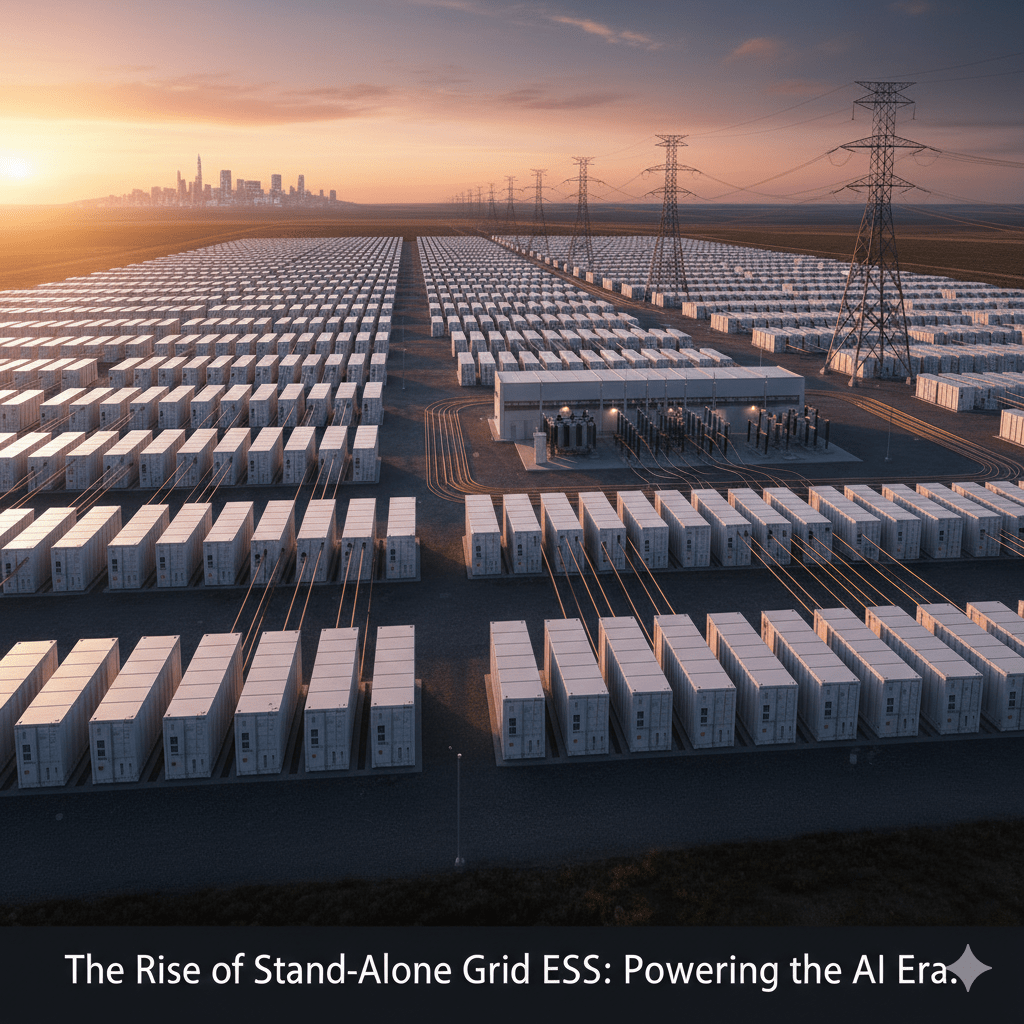
The Pivot to Stand-Alone Grid Assets in the AI Era
For years, Energy Storage Systems (ESS) were viewed merely as “add-ons” to solar and wind farms. However, the data from late 2025 reveals a massive structural shift: ESS is gaining independence. It is no longer just supporting renewables; it is becoming a standalone pillar of the modern power grid.
Let’s break down the December 2025 surge and what it means for the future of energy infrastructure.
1. The December Surge: A 95% YoY Explosion
The numbers for December 2025 are staggering. Global ESS installations hit 77.1 GWh, nearly doubling from the previous year.
- 2025 Cumulative Growth: 314.0 GWh (+49% YoY)
- The Grid Dominance: A whopping 92% of new capacity was grid-connected.
But the real story isn’t just the volume—it’s the mix. While solar-linked ESS saw a 60% decline, Stand-alone BESS surged by 225%. The market is moving away from weather-dependent storage toward independent grid assets.
2. Why Stand-Alone ESS is Winning: The AI Factor
Why is the market abandoning generation-linked storage in favor of stand-alone systems? The answer lies in the shifting nature of power demand, largely driven by AI infrastructure.
- Breaking the Weather Chain: Solar and wind-linked storage can only charge when the sun shines or the wind blows. Stand-alone ESS can charge from the grid at any time, providing 24/7 reliability.
- Data Center Demands: AI data centers don’t just need power; they need stability. Stand-alone ESS is better suited for high-frequency regulation and rapid discharge to prevent even a micro-second of downtime
3. Regional Spotlight: China vs. The U.S. 🇨🇳 🇺🇸
- China (The Sprint): China was the primary engine behind the December spike, completing a concentrated wave of massive stand-alone projects (67.9 GWh in one month!).
- United States (The Marathon): While December saw some short-term volatility, the long-term trajectory remains solid with 21% full-year growth. The focus here is on steady, multi-year deployment.
4. Tech Trend: LFP is the Undisputed King
Safety and cost have officially beaten energy density in the ESS race.
- LFP Dominance: 95.9% of the market.
- Why? ESS units now cycle dozens of times a day. Cycle life and thermal stability (safety) are now the most critical metrics for grid operators.
Final Thoughts
The ESS market has reached an inflection point. It is evolving from a niche “green” auxiliary into a core infrastructure asset essential for the AI-driven economy. For investors, the play is no longer just about “renewables”—it’s about the infrastructure of grid stability.
 The Morning Calm Notebook
댓글 남기기