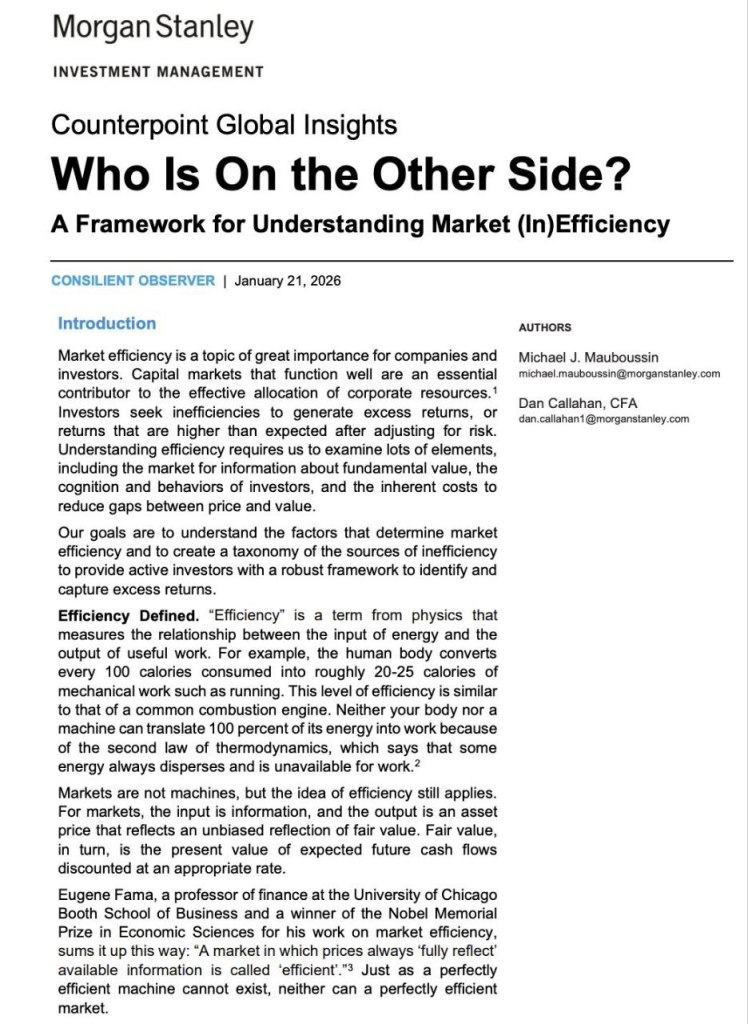
Understanding Why the Market is “Forced” to be Wrong
To generate excess returns (Alpha), investors must first answer a simple, yet uncomfortable question: “Who is taking the opposite side of my trade?” Alpha doesn’t come from just being right; it comes from understanding why someone else is willing—or forced—to be wrong.
1. Market Efficiency: The Physics of Finance
We often talk about “efficient markets,” but perfect efficiency is a myth. Think of it through the lens of physics:
- The Energy Analogy: In biology, only about 20–25% of the calories we consume are converted into mechanical work; the rest is lost as heat. This is the Second Law of Thermodynamics.
- Information as Energy: In the markets, Information is the input and Price is the output. Just as an engine loses energy to friction, the market loses information to delays, distortions, and misunderstandings. Prices can never perfectly reflect fair value in real-time.
2. The Myths of Eugene Fama
The University of Chicago’s Eugene Fama, a Nobel laureate, is the father of the Efficient Market Hypothesis. However, his message is often misunderstood.
The point was never that markets are perfect. Rather, markets are efficient enough to eliminate easy profits, but never efficient enough to eliminate all opportunities. Inefficiency is where alpha begins.
3. Identifying the “Constrained” Counterparty
If you buy an asset because it’s undervalued, someone else is selling it because they think it’s expensive—or because they have to sell. True alpha is found when your counterparty is:
- Structurally Forced: Selling due to fund mandates, margin calls, or liquidity needs.
- Informationally Disadvantaged: Operating with incomplete or inferior data.
- Psychologically Constrained: Influenced by behavioral biases rather than hard valuation.
Final Thought
Markets are not inefficient because people are irrational; they are inefficient because participants are constrained by rules, incentives, and time horizons.
Next time you trade, don’t just ask if the market is wrong. Ask: “Why is the other side willing—or required—to take this trade?” That is where your edge truly lies.
 The Morning Calm Notebook
댓글 남기기